
Chess Puzzle Strategy: The Checks, Captures, and Threats Scan That Finds Winning Moves
The Simple Scan That Organizes a Complicated Position
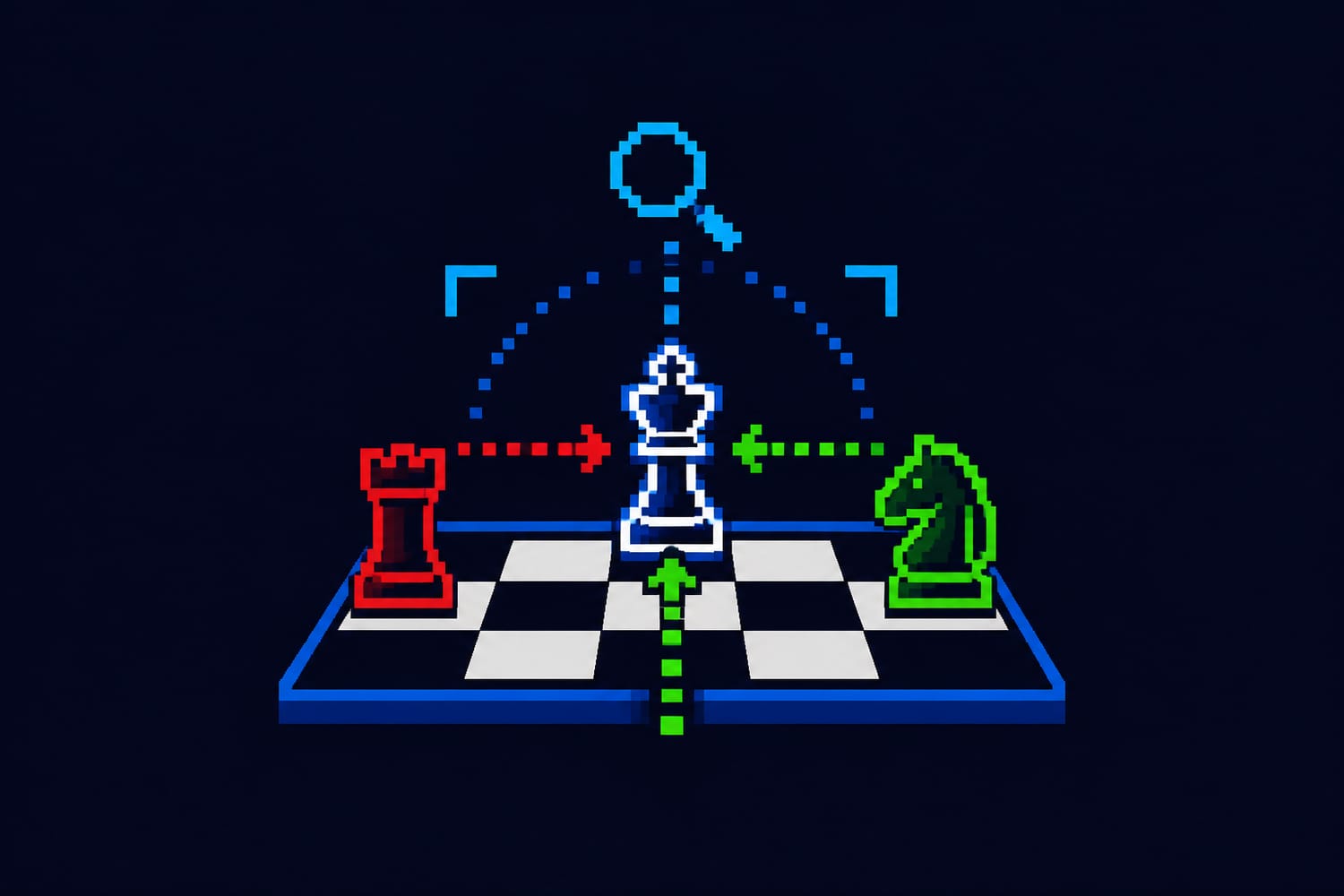
The checks, captures, and threats scan, often shortened to CCT, is a practical way to find winning moves in chess puzzles. Before choosing a move, examine every legal check, promising capture, and serious threat. Then calculate the opponent’s strongest response and repeat the scan until the position becomes clear.
Chess positions can feel overwhelming because almost every piece appears to offer possibilities. CCT turns that confusion into an orderly search. It does not solve the puzzle automatically, but it helps you examine forcing moves before drifting toward slower ideas.
This method works for beginners learning basic tactics, experienced players sharpening calculation, and anyone who has ever looked at a puzzle solution and wondered, “How was I supposed to see that?”
Why Checks, Captures, and Threats Come First
Checks, captures, and threats are important because they often restrict what the opponent can do. A quiet move may leave dozens of reasonable replies, while a forcing move can narrow the response considerably.
For example:
- A check must be answered immediately.
- A capture changes the material or structure of the position at once.
- A threat creates an urgent consequence, such as checkmate or the loss of a valuable piece.
This smaller reply tree makes tactical calculation more manageable. As explained in this guide to forcing moves in chess, checks, captures, and mating threats can limit an opponent’s choices and help a player predict how the position will develop.
However, CCT is a search order—not a command to play the first check you see. A useless check may drive the enemy king to safety, and a tempting capture may lose your queen. The purpose of the scan is to create good candidate moves that you can test.
Step One: Examine Every Legal Check
Checks usually deserve attention first because the opponent cannot ignore an attacked king. Under the official FIDE Laws of Chess, a player may not leave their king under attack or make a move that exposes it to attack. Checkmate occurs when the king is attacked and no legal response exists.
When scanning checks, include more than obvious queen and rook moves. Look for:
- Knight checks
- Pawn checks
- Discovered checks
- Double checks
- Sacrificial checks
- Checks created by promotion
- Long-range bishop, rook, or queen checks opened by moving another piece
For each check, ask how the opponent can respond. Depending on the position, the defender may be able to:
- Move the king to a safe square.
- Capture the checking piece.
- Block a line check with another piece.
Not every option is available against every check. A knight check cannot be blocked, for example, while double check can only be answered by moving the king.
Now follow the line. If you play the check and the king moves, what changed? Perhaps the king stepped onto a square where it can be forked. Maybe a defender was forced away from a rook. Perhaps the checking move opened a line for another attacker.
The best check is not always immediate checkmate. It may be the first step in a combination that wins material several moves later.
Step Two: Investigate Captures Carefully
After checks, inspect every capture—not only captures of valuable pieces. Tactical puzzles frequently use exchanges, sacrifices, and intermediate captures to remove defenders or open lines.
Start with the most promising possibilities:
- Can you capture an undefended piece?
- Can you take a more valuable piece with a less valuable one?
- Can you remove a defender of the king?
- Can you capture a pinned piece?
- Can you open a file, rank, or diagonal?
- Can you sacrifice material to create a stronger follow-up?
Do not stop after noticing that a capture “wins a rook.” Place the move mentally on the board and calculate the opponent’s best reply. If the captured piece is defended, examine the full exchange rather than evaluating only the first move.
Suppose your bishop can capture a rook, but the opponent’s queen can recapture. That may appear unfavorable—until you notice that removing the queen allows a back-rank checkmate. The meaning of a capture depends on what becomes possible afterward.
Also watch for zwischenzugs, or intermediate moves. Instead of automatically recapturing, either player may have a check, stronger capture, or major threat that changes the order of events.
Step Three: Search for Concrete Threats
If no check or capture works, look for threats. A useful tactical threat has a clear consequence that the opponent must prevent.
Common examples include threatening to:
- Deliver checkmate
- Win a queen or rook
- Create a fork
- Pin or skewer a major piece
- Promote a pawn
- Trap a piece
- Remove a crucial defender
- Launch a discovered attack
- Create two attacks at once
A move such as “improve the knight” may be strategically sensible, but it is not necessarily a forcing threat. In a tactical puzzle, ask what you will do on the next move if the opponent does nothing.
For instance, imagine that moving your queen threatens checkmate on h7. The opponent may be forced to create an escape square, defend h7, trade queens, or counterattack with something even stronger. Your job is to calculate those defenses—not merely admire your threat.
Double threats are especially powerful because one defensive move may not solve both problems. A knight fork, for example, can attack the king and queen simultaneously. Because the check must be answered, the queen may be lost afterward.
Use the Scan for Both Sides
One of the biggest CCT mistakes is using it only to search for your own attack. Before committing to a move, switch perspectives and perform the same scan for the opponent.
Ask:
- What checks will my opponent have?
- What can they capture?
- What checkmate or material threat can they create?
- Did my move leave a piece undefended?
- Did I open a line toward my own king?
- Can they ignore my idea and play something stronger?
This defensive scan prevents “hope chess”—playing a move without confirming that you can meet the opponent’s forcing reply. A detailed discussion of spotting and avoiding tactics recommends checking the opponent’s possible checks, captures, and threats when evaluating candidate moves.
The habit also fits naturally with Puzzles Arcade’s pre-move puzzle checklist: pause, test the move, and make sure it survives contact with the puzzle’s rules and consequences.
A Five-Step Routine for Solving Chess Puzzles
Use this complete routine whenever you face a tactical position:
- Read the position. Identify whose turn it is, check whether either king is already in danger, and note loose or overloaded pieces.
- Generate candidates. List every legal check, promising capture, and concrete threat.
- Prioritize forcing moves. Begin with checks and moves that leave the opponent few reasonable replies.
- Calculate the best defense. Never assume the opponent will cooperate or make the most obvious move.
- Perform a final blunder check. Confirm that your chosen move is legal and does not allow a stronger check, capture, or threat.
Continue the CCT scan after every imagined reply. A tactical sequence might look like:
Your check → opponent’s best defense → your capture → opponent’s countercheck → your winning threat.
Stopping after the first move is one of the most common reasons puzzle solvers choose an attractive but incorrect answer.
Common Mistakes That Hide Winning Moves
Playing the First Available Check
Checks feel exciting, but some accomplish nothing. Compare all checks before choosing one and ask where the king will go.
Assuming Every Capture Is Good
A free-looking piece may be protected tactically. The opponent could recapture, pin the capturing piece, or deliver an intermediate check.
Making a Vague Threat
“Attacking the kingside” is a plan, not necessarily an urgent threat. Define the exact consequence: What will I play next?
Ignoring the Opponent’s Best Defense
Puzzle solutions are built against accurate resistance. If your combination works only when the opponent makes a weak reply, it probably is not the solution.
Focusing on One Area of the Board
A kingside attack may fail because of a countercheck from the opposite corner. Scan the entire board, including long diagonals and distant rooks.
How to Turn CCT Into a Reliable Habit
At first, the scan may feel slow. That is normal. Accuracy should come before speed.
Practice with positions that give you enough time to name the candidates before moving. You can even say them quietly: “Checks, captures, threats—for me, then for my opponent.” Over time, familiar patterns such as forks, pins, back-rank mates, and overloaded defenders will become easier to recognize.
A short, focused routine is usually more valuable than racing through large numbers of puzzles. The principles in building a daily puzzle practice apply perfectly to chess: choose an appropriate difficulty, solve thoughtfully, and review mistakes rather than measuring progress only by quantity.
Find the Move—and Prove It Works
The checks, captures, and threats scan gives your chess thinking a dependable starting point. Look at checks first, investigate captures, search for concrete threats, and then repeat the process from the opponent’s side.
Most importantly, do not merely find a move that looks winning. Prove it by calculating the strongest reply. With patient practice, CCT becomes more than a puzzle technique: it becomes a lasting habit that helps you notice opportunities, avoid blunders, and approach every chess position with greater confidence.

