
2048 Strategy for Beginners: Build a Corner and Avoid Dead Ends
Start With a Plan, Not a Swipe
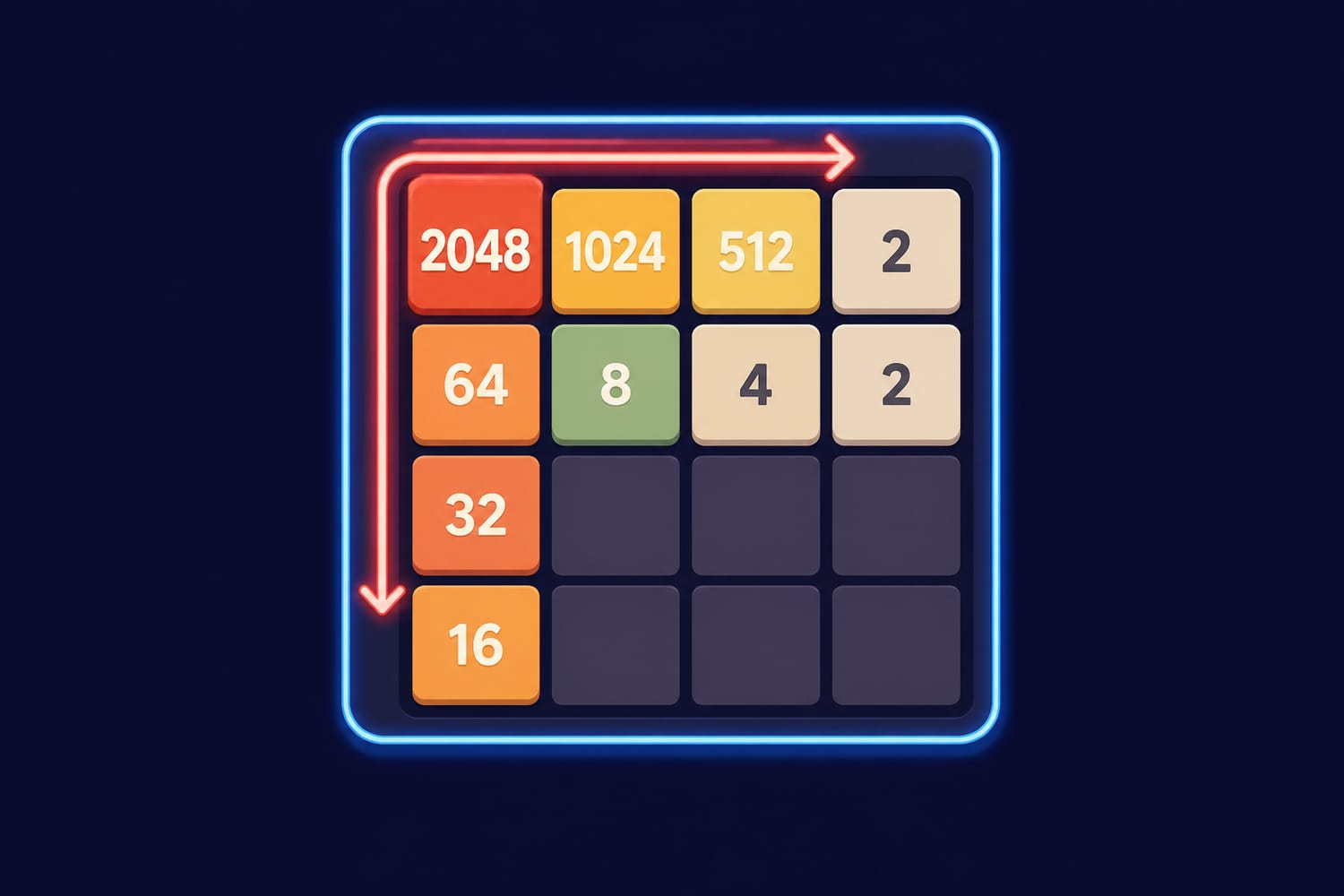
The simplest beginner strategy for 2048 is to keep your largest tile in one corner, arrange the next-largest tiles along the nearby edge, and preserve room for new tiles. Before every move, ask whether it helps you merge and leaves you somewhere useful to go next. A tidy board matters more than one exciting merge.
That is the difference between building toward 2048 and watching a promising game end in a grid full of numbers that cannot meet.
Know What Each Move Really Does
In the original 2048 game, you slide every tile on a 4-by-4 grid at once. Two tiles with the same number merge when a move brings them together: two 2s make a 4, two 4s make an 8, and so on. After a successful move, a new small tile appears in an empty space. Your aim is to create a 2048 tile.
The important word is every. A swipe does not move only the pair you have spotted; it changes whole rows or columns. Before merging two 16s, look at what happens to the 64 beside them, the empty spaces elsewhere, and the path you will need afterward.
A full board is not automatically the end: adjacent equal tiles may still merge. A board with an empty space is not automatically safe, either. That space helps only if your next moves can use it.
Build Your Biggest Tile in a Corner
Pick a corner early and treat it as your home base. For the examples in this guide, imagine choosing the bottom-left. Your largest tile belongs there, while smaller tiles approach it from the right and above.
Why a corner? It gives your biggest tile a predictable place and makes it easier to organize the rest of the board around it. A useful goal for the bottom row might look like this:
| Bottom-left | | | Bottom-right | |---|---|---|---| | 128 | 64 | 32 | 16 |
This is a target pattern, not a row you must create exactly. Keeping larger tiles generally closer to your chosen corner makes it easier to bring equal values together without scattering your progress. A paper on 2048 strategy likewise describes a corner-based, descending “snake” arrangement as a useful pattern—while noting that a perfect arrangement cannot always be maintained.
For a bottom-left corner, left and down are your usual directions: they push tiles toward your chosen edges. Right sometimes helps you set up a merge, but it can pull your largest tile away if the bottom row has a gap. Up can lift it off the bottom edge, so use that direction with particular care.
Feed the Corner With a Loose “Snake”
Once your largest tile is settled, think about the next-largest one. Ideally, it sits beside the corner tile or can be guided there. Smaller values can continue along the bottom edge, then wind back across the row above. Picture a path that bends like a snake, with numbers generally getting smaller as you move away from its head.
You do not need a perfect sequence. New tiles appear in spaces you do not choose, and useful merges will rearrange the grid. The beginner-friendly version is simply: keep your biggest values together and give smaller values a route toward them.
Suppose your bottom row, from left to right, contains 64, 32, 16, 8. Another 8 appears above the right side. Your short-term task is to combine the 8s without disturbing the 64. Later, two 16s can make a 32, and two 32s can make a 64. Thinking in stages is less overwhelming than trying to create your next largest tile immediately.
This is also a good way to practice seeing the whole board. If mentally sliding a row feels tricky, Puzzles Arcade’s guide to visualization in tiling and block-based games offers ideas for picturing how pieces will move before you act.
Protect Empty Spaces—and Useful Pairs
Empty cells are breathing room. They let tiles slide into position and provide places for new tiles to appear. But counting empty cells alone can mislead you: a move that opens one square while separating all your matching tiles may leave you worse off.
Look for useful pairs as well as open space. If two 8s share a row but have a 4 between them, a horizontal swipe will not magically merge the 8s. You need a way to move the 4 or bring the 8s together through another row or column.
A quick check before a crowded-board move is:
- Will this merge equal tiles or set up a clear merge?
- Where will my largest tile finish?
- Will I still have an open space or another productive move afterward?
If you cannot answer the third question, pause. That attractive merge might be the beginning of a dead end.
Avoid the Three Most Common Dead Ends
Chasing every merge. A pair of 2s at the top can be tempting, but bringing them together may scramble a carefully ordered bottom row. Small merges are valuable when they support your route toward the corner—not simply because they are available.
Alternating directions automatically. Repeatedly pressing left and down can keep tiles near your chosen edges, but it cannot solve every position. Eventually, you must decide which pair you are building and whether a third direction is needed. A strategy is a way to make decisions, not a button sequence.
Trapping large tiles behind smaller ones. Imagine a row containing 64, 4, 64, 2. The two 64s cannot merge while the 4 sits between them. The bigger the tiles become, the more costly these barriers feel. Try to keep your largest values near one another in an order you can work with.
For more on the number relationships behind these merges, see Puzzles Arcade’s article on the hidden math behind puzzle games.
What If You Must Break the Corner Rule?
“Never move your largest tile” is a helpful reminder, but it is not an unbreakable law. Sometimes your preferred directions produce no useful move, and the only way to keep playing is to swipe away from your corner.
Before you do, inspect the row or column holding your anchor tile. A swipe in the risky direction does not necessarily dislodge it if that line cannot shift; in other positions, it will move at once. If it must move, choose the option that leaves the clearest route back. Afterward, reassess the new board before trying to restore the corner—a new tile may have appeared where you hoped to return.
That small pause is more useful than a panicked series of corrective swipes. You are not trying to defend a rule at any cost; you are trying to keep the board playable.
Practice One Habit at a Time
Your first goal does not have to be 2048. Try a game where you focus only on keeping your largest tile in its chosen corner. In the next, add a second goal: place the next-largest tile close to it. Then practice pausing before each move when the board starts to fill.
You can also give yourself a simple challenge: before swiping, say where your largest tile will land and which pair you hope to combine next. If the move does something unexpected, look at why. Those little surprises teach you more than racing through another round.
The corner strategy will not make every game predictable; new tiles still arrive where you cannot choose. But it gives each move a purpose. Protect your anchor, guide equal tiles together, and leave yourself room to keep playing. That is how a board that once looked chaotic starts to feel like a puzzle you can plan your way through.

