
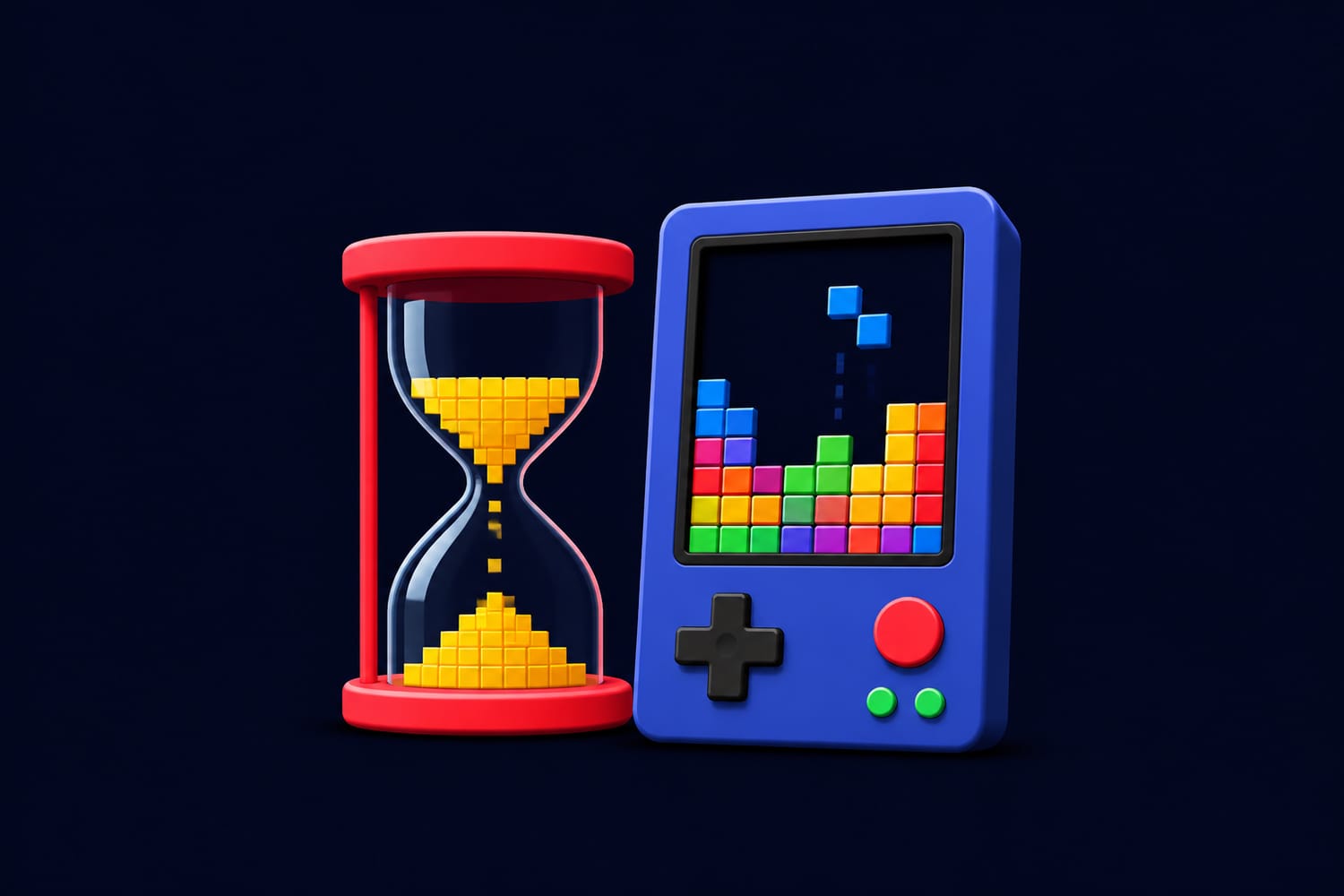
Why Puzzles Make Waiting Feel Shorter: The Psychology of Occupied Time
A puzzle cannot make a line move faster. It can, however, change what the wait feels like. When you are searching for a word, testing a number or spotting a pattern, you have less attention left to spend watching the minutes pass. The clock keeps going at the same speed; your experience of those minutes can change.
Picture two ten-minute waits. In the first, you stand by a door, wondering when it will open. In the second, you work through a small crossword. You may still notice the delay, but you also have clues to consider and little moments of progress. That difference is the idea behind occupied time: a wait often feels easier when it contains something engaging to do.
Why Empty Minutes Can Feel So Long
Waiting is unusual because your main goal—getting on the bus, seeing the doctor, collecting your food—is temporarily out of your hands. With little else to do, attention can drift toward questions such as “How much longer?” Each glance at the clock brings the wait back to the center of your thoughts.
Psychologists distinguish between how long you think an interval lasted and how quickly time seemed to pass while you were in it. Those judgments do not always agree. In one study of lengthy waits, people sitting passively initially reported that time passed more slowly than people who could walk around, yet the passive group later gave shorter estimates of the wait’s duration. Feeling that time dragged is not the same as estimating more minutes afterward.
That distinction explains a familiar experience: an uneventful wait can be tedious while it happens, then seem surprisingly brief in memory. The aim of a waiting-time puzzle is not to trick yourself into reporting a smaller number. It is to make the minutes themselves more pleasant.
How a Puzzle Occupies Your Attention
A good puzzle gives your mind a question it can act on: Where is that word? Which piece fits? What number is possible here? Unlike the open-ended question “When will this be over?”, those questions offer next steps. You can scan another row, rule out an answer or try a new arrangement.
Researchers sometimes explain time perception using an attentional-gate model. In simple terms, when more attention goes to an activity, less goes to tracking time. It is a useful way to understand why an absorbing task may make an interval seem shorter, though it is not a promise that every puzzle will have the same effect for every person.
Puzzles also provide visible progress. A found word, a completed corner or a solved clue gives you a small result before the larger wait is over. That matters when the thing you are waiting for is beyond your control: you may not be able to call the next appointment, but you can decide what to try next in the puzzle.
What Studies of Waiting Actually Show
The broad idea—that an activity can make waiting feel less tedious—has research behind it. In a laboratory study involving a wait of seven and a half minutes, participants who had a task reported less boredom and felt that time passed faster than those who waited passively. The finding did not depend simply on whether the activity was digital; having something to engage with appeared important. You can read the study of activities during a short wait for the details.
A different study of active and passive waiting found a more complicated pattern during waits lasting over an hour. Activity helped with the early feeling that time was dragging, but that difference faded as the wait continued. The researchers also found that estimates of elapsed time did not neatly follow how fast time had felt.
These studies did not test every kind of puzzle in every waiting situation. They support a sensible expectation, not a guarantee: an enjoyable task may improve the experience of waiting, especially when the alternative is doing nothing but monitoring the delay.
Why Puzzles Are Particularly Handy for Waiting
Not all activities fit neatly into a spare few minutes. A film may be hard to stop at a satisfying point; a complicated project may require materials you do not have. Many puzzles are easier to carry, start and pause. A word search works on paper or a screen, while a riddle needs no equipment at all.
Different puzzles suit different moods:
- For a brief, uncertain wait: Try a word search, a short riddle or a small matching puzzle. You can stop when your turn comes.
- For a longer, quieter wait: Try a crossword, Sudoku or a logic puzzle with room to work through possibilities.
- For a restless child or a companion: Look for shapes together, trade easy clues or make up a “spot five things” challenge.
- For a tiring day: Pick something familiar and gentle rather than a timed challenge that adds pressure.
If you have a phone and want an immediate goal, Puzzles Arcade’s Word Search with hints asks you to find hidden words in a letter grid. If you would rather plan moves than scan letters, Arrow Escape offers an arrow-path challenge. Neither is the right choice for everyone; the useful choice is the one you enjoy at that moment.
The Other Part of Waiting: Not Knowing How Long It Will Be
A puzzle can occupy you without answering the question of when your turn will come. If you are worried about missing your name being called—or about being late for something afterward—it may be hard to settle into any game.
That is why information helps, too. In a study of patients’ waiting experiences, people described uncertainty about delays as a source of frustration. The researchers identified updates and opportunities for diversion as ways clinics could improve the experience. A puzzle is one useful piece of the picture; a realistic update about the queue can address a different concern.
In practice, ask for an estimate if one is available, keep an ear open for announcements and choose an activity you can pause quickly. On a platform, in a moving line or anywhere your surroundings need your attention, safety comes before the next clue.
Make the Puzzle Fit the Moment
The best waiting-time puzzle is absorbing without becoming another demand. If a difficult level makes you irritated, switch to an easier one. If a bright screen bothers your eyes, try paper. If you want to talk with the person beside you, share a clue instead of disappearing into your phone.
Familiar rules can be especially welcome when you are already tired: you can begin playing without first learning a new system. For more on that feeling, see Puzzles Arcade’s article on why familiar puzzles feel comforting.
Sometimes the better choice is not to fill the time. You might want to rest, look around, stretch if appropriate or simply let your mind wander. And when a wait involves serious worry, a puzzle may offer a brief break without removing the worry itself. There is no need to force yourself to play.
A Different Way to Spend the Same Minutes
Puzzles do not shorten the appointment delay, repair the traffic jam or speed up the person ahead of you. Their benefit is smaller and more practical: they give your attention somewhere enjoyable to go while those minutes pass.
The next time you find yourself waiting, try a challenge that fits the setting—a hidden word, a clue or one move in a logic game. You may still have to wait just as long. But instead of measuring every minute by what has not happened yet, you can spend some of them making progress on something right in front of you.

