
Inside a Rubik’s Cube: The Hidden Mechanism That Makes Every Twist Possible
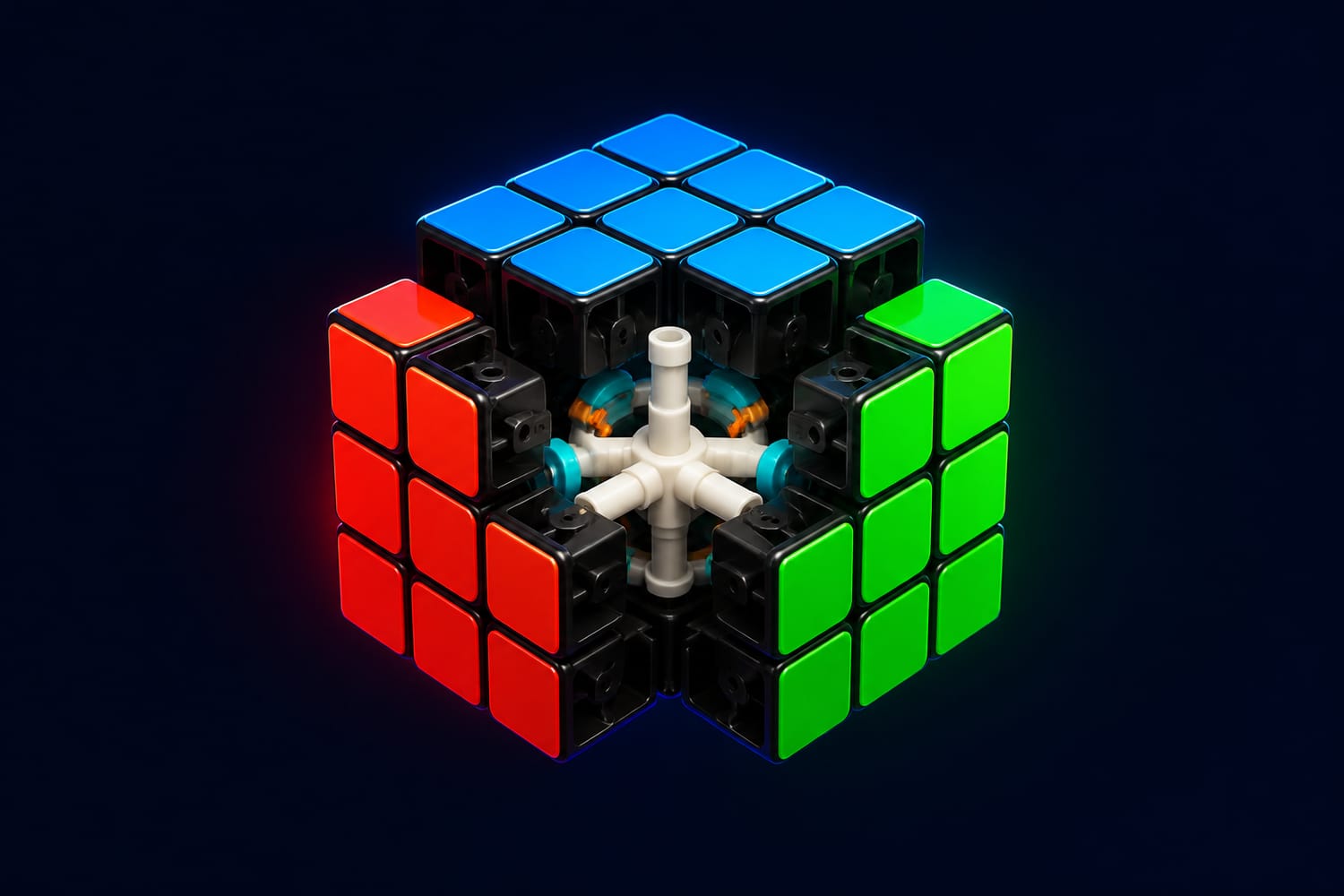
A standard 3×3 Rubik’s Cube turns because its colored pieces are not separate blocks stacked together. Six center pieces connect to an internal core, while specially shaped edges and corners interlock around them. Hidden curved surfaces let these pieces slide through each turn without the puzzle falling apart.
That is the clever contradiction at the heart of the cube: it must hold together securely while allowing sections to move in different directions. The colorful exterior hides a mechanical puzzle almost as fascinating as the challenge of solving it.
Let’s look beneath the surface—without needing to pry anything apart.
The Invention Before the Scramble
Ernő Rubik created his cube in 1974. Before it became an international puzzle phenomenon, its design presented a fundamental challenge: how could parts of a cube move relative to one another while remaining connected? Rubik’s breakthrough involved shaping the hidden portions of the pieces so they could move around a rounded interior.
An early wooden prototype did not even have colors, Rubik explained in an interview with Guinness World Records. That makes a useful distinction: the mechanism was an invention in its own right, not merely packaging for a color-matching game.
The puzzle launched internationally under the Rubik’s Cube name in 1980. But the engineering achievement was already there: a handheld object that could rearrange itself without coming undone.
It Looks Like 27 Blocks, but It Isn’t
Imagine building a solid cube from smaller cubes, three across, three high, and three deep. You would need 27 blocks.
A standard Rubik’s Cube is different. As the Smithsonian’s description of the puzzle explains, it has 26 visible pieces, with a mechanism occupying the space at its center. Those visible pieces fall into three groups:
- 6 centers: Each displays one colored square.
- 12 edges: Each displays two colored squares.
- 8 corners: Each displays three colored squares.
Together, these provide the 54 colored squares visible across the six faces. Crucially, those squares are not 54 independently moving tiles: the colors on an edge or corner belong to one physical piece.
A red-and-blue edge therefore stays a red-and-blue edge throughout a scramble. It can change location and orientation, but its two colors travel together. Thinking in whole pieces, rather than isolated colored squares, makes the puzzle much easier to understand.
The Core: A Hidden Framework with Six Directions
In a familiar 3×3 mechanism, the core resembles a small three-dimensional cross, with six arms pointing toward the six face centers. Picture three rods crossing at right angles: left to right, top to bottom, and front to back. The six center pieces attach around this framework.
The disassembled cube photographs in James Storer’s Brandeis University puzzle collection show this arrangement clearly: a central axis assembly surrounded by 20 interlocking edge and corner pieces.
This explains what cubers mean when they say the centers are “fixed.” During ordinary face turns, the centers do not exchange places around the core. A center can rotate around its own axis, but it does not travel to another face.
For solving, that makes the centers useful reference points. If a face has a blue center, that is where the blue face belongs when the puzzle is solved. You are arranging the surrounding pieces to match an existing framework, not choosing six new face colors.
The Real Secret Is Underneath Each Piece
The visible part of a corner looks like a little cube with three colored sides. Its hidden underside is a different shape.
Edges and corners have inward-projecting sections that interlock with neighboring parts. These concealed extensions prevent the pieces from simply falling outward, while curved contact surfaces allow them to slide as a layer rotates. They are not individually screwed to the core.
A useful analogy is a drawer running in a retaining track: it can slide along an allowed path without dropping out. The cube accomplishes something more intricate because its pieces must participate in turns around different axes.
The important idea is controlled freedom. The mechanism permits particular movements while restricting others. Its hidden geometry—not the colored stickers or tiles—is what makes the twisting possible.
What Actually Happens During a Quarter-Turn?
Consider turning the top face through 90 degrees.
Four top-layer corners move to new corner positions, and four top-layer edges move to new edge positions. The top center rotates in place. Mathematically, that turn cycles the four corners and the four edges around the face.
Mechanically, the pieces’ hidden surfaces slide past one another while remaining interlocked. Once the quarter-turn is complete, the puzzle’s rows line up again, ready for a turn in another direction.
Try this thought experiment: turn the top, then the right face. Now reverse the order. The results are generally different because the first move changes which pieces the second move will affect. That interaction is part of what makes a seemingly simple object such a rich puzzle.
Why Some Cubes Feel Tight and Others Feel Flexible
A cube needs enough pressure to remain stable, but enough clearance to turn.
Many conventional designs use screws and springs in the center assemblies. These provide a resilient connection rather than clamping every part into a completely rigid structure. Different adjustment systems change the puzzle’s tightness and the permitted movement of its centers.
Two settings are especially useful to distinguish:
- Tension or elasticity affects the resistance of the mechanism.
- Center travel concerns how far a center can move outward along its axis.
Their effects interact, and adjustment methods vary between models. Too much looseness can compromise stability; too little freedom can make turning difficult. There is no single setting that suits every cube and every solver.
This is why randomly tightening or loosening a screw is not a universal fix. A model’s own adjustment instructions are the better starting point.
How Speedcubes Refine the Same Basic Idea
Modern speedcubes build on the same broad challenge: keep the pieces retained while making their movement easier to control.
One refinement is corner cutting—completing a turn when an adjoining layer is slightly misaligned. It does not involve cutting anything. The puzzle’s geometry and available movement allow a degree of misalignment to be accommodated, with center-travel and tension settings affecting that tolerance.
Another refinement is magnetic positioning. Small magnets help guide layers toward alignment and give turns a more controlled finish. As GANCUBE’s explanation of cube systems describes, the magnetic system and the tension system serve different purposes: one assists alignment, while the other influences the puzzle’s mechanical feel.
Some designs also replace traditional springs with repelling magnetic rings, often described as “maglev.” These provide a spring-like restoring force, but they do not make the entire cube float or eliminate all contact between its moving pieces.
The Mechanism Also Creates the Puzzle’s Rules
The cube’s construction gives every move boundaries. Corners remain corners, edges remain edges, and ordinary turns move groups of pieces rather than allowing arbitrary rearrangements.
These restrictions have surprising mathematical consequences. Starting from a solved standard 3×3, normal turns cannot produce a position with just one twisted corner, just one flipped edge, or exactly two pieces exchanged while everything else remains solved. Such positions require an alteration outside normal turning, such as incorrect reassembly.
Yet within its rules, the standard cube has 43,252,003,274,489,856,000 possible positions—roughly 43 quintillion. An elegant interior mechanism supports an extraordinary range of arrangements.
That connection between physical limits and playful possibility is part of the appeal of looking behind the games at Puzzles Arcade. The rules are not always printed in a booklet; sometimes they are built into the object.
The next time you twist a Rubik’s Cube, look beyond the shifting colors. Every turn is a small demonstration of an ingenious balance: pieces free enough to move, yet constrained enough to remain a puzzle.

