
Wolf, Goat, and Cabbage: How One River-Crossing Puzzle Travels Across Cultures
One Small Boat, One Remarkably Well-Traveled Puzzle
The wolf, goat, and cabbage puzzle is a river-crossing challenge with a surprisingly wide cultural reach. Recorded in a medieval collection traditionally attributed to Alcuin of York, it also appears in African and European traditions. Its characters and settings change, but the central challenge remains: move everyone safely without leaving the wrong pair together.
Why does such a small story travel so well? You do not need a special board, advanced mathematics, or even pencil and paper to share it. A few rules create a predicament that is easy to picture—and wonderfully tricky to untangle.
The Puzzle: Who Crosses First?
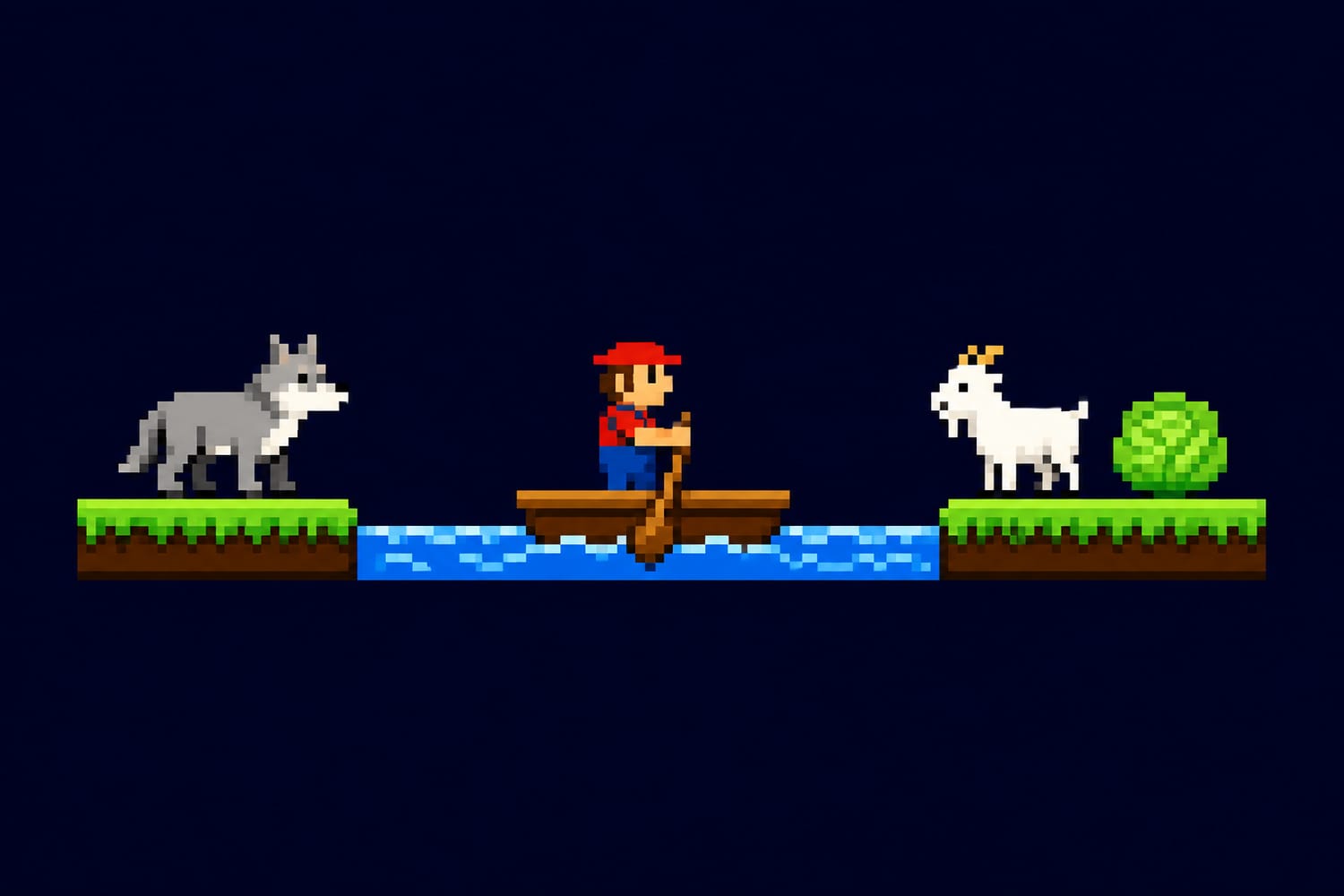
Imagine a traveler arriving at a river with a wolf, a goat, and a cabbage. There is a boat, but it carries only the traveler and one passenger or item at a time.
The rules are simple:
- The traveler must operate the boat on every crossing.
- The wolf cannot be left with the goat without the traveler.
- The goat cannot be left with the cabbage without the traveler.
- The wolf and cabbage can safely remain together.
The goal is to get everyone and everything to the opposite bank unharmed. These are the familiar constraints of the classic puzzle.
Before reading further, consider the first crossing. Taking the wolf leaves the goat with lunch. Taking the cabbage leaves the wolf with lunch. That makes the goat the only safe first passenger.
But getting started is not the same as getting finished.
A Medieval Record, Not a Certain Birth Certificate
A famous early written version appears as problem 18 in Propositiones ad acuendos iuvenes, usually translated as “Problems to Sharpen the Young.” The collection dates to around AD 800 and is traditionally attributed to Alcuin of York. The University of St Andrews’ MacTutor account of the collection explains that its authorship is not certain and that Alcuin may have collected puzzles rather than invented them all.
That distinction matters. An early surviving record tells us that a puzzle existed by a particular period; it does not necessarily identify its first storyteller.
It is therefore safer to describe this as a puzzle recorded in a collection associated with Alcuin, rather than confidently declaring that he invented it. The collection also includes other river-crossing challenges, placing our hungry trio within a larger medieval tradition of recreational problems.
For another exploration of a brain teaser’s long cultural life, see Puzzles Arcade’s article on how the Riddle of the Sphinx traveled the world.
Across Cultures, the Cast Can Change
The most revealing comparisons are not always between identical tellings. Sometimes a different animal or food makes the underlying pattern easier to recognize.
Liberia: A Leopard and Cassava Leaves
A version reported from the Kpelle people of Liberia replaces the wolf with a leopard and the cabbage with cassava leaves. The goat remains in the middle: vulnerable to the predator, but dangerous to the plant food.
This example is discussed in an African Mathematical Union newsletter on the history of mathematics in Africa, drawing on Claudia Zaslavsky’s work. The newsletter also notes Marcia Ascher’s cross-cultural study of river-crossing problems from several African settings.
The substitution preserves the puzzle’s essential relationship:
Predator → plant-eating animal → plant food
From a solver’s perspective, the animal names matter less than knowing which pairs cannot safely be left together.
Estonia and Finland: Changing the Landscape
Folklorist Piret Voolaid documents Estonian versions told both as stories and as question-and-answer riddles. Her study also discusses a Finnish example featuring a wolf, a sheep, and a cabbage, with the destination changed to an island. The same predicament works across a lake rather than a river.
Such examples suggest a useful way to understand adaptation: a puzzle can remain recognizable without preserving every detail. The water, boat, and incompatible companions provide a durable framework.
They do not, however, establish a complete route of transmission. A matching solution is not, by itself, proof of who borrowed from whom.
The Seven-Crossing Solution
Ready to get the travelers across? Here is one shortest solution:
- Take the goat across.
- Return alone.
- Take the wolf across.
- Bring the goat back.
- Take the cabbage across.
- Return alone.
- Take the goat across again.
The Julia Robinson Mathematics Festival’s explanation confirms that the classic puzzle has two shortest solutions, each requiring seven crossings. In the other solution, the cabbage travels on the third crossing and the wolf on the fifth.
The surprising move is number four. You have just delivered the goat, yet you must bring it back.
Look closely at what that accomplishes. Once the goat returns, the wolf can wait safely on the far bank. You can then deliver the cabbage to the wolf, leaving the goat temporarily on the starting bank. The remaining task is simply to fetch the goat.
Moving backward is what makes forward progress possible.
Why the Trick Works—and Why It Takes Seven Trips
Rather than memorize the answer, try rebuilding it from the restrictions.
First, the goat must cross because neither alternative leaves a safe pair behind. Next, the traveler must return alone: bringing the goat straight back would merely undo the opening move.
Now either the wolf or the cabbage can cross. Whichever you choose, it cannot remain with the goat when the traveler leaves. The goat must therefore return.
This is an example of eliminating impossible moves, rather than guessing at a complete solution. For a broader introduction to that approach, explore Puzzles Arcade’s guide to process of elimination in logic puzzles.
You can also build a short argument for the minimum number of crossings:
- Three items must make a forward journey.
- At least one item must also come back, as the opening sequence demonstrates.
- That returned item needs another forward journey.
So there must be at least four forward crossings. Because the boat alternates banks, four forward crossings require three return crossings between them: seven altogether. The solution above achieves that lower bound.
This reasoning is more useful than a remembered sequence. It explains why a shorter answer cannot satisfy the same rules.
From Spoken Riddle to Screen
Folklorists classify this story pattern as ATU 1579, a number in the Aarne–Thompson–Uther tale-type index. Voolaid’s study of the puzzle’s transformations follows it across narrative, riddle, illustrated, and interactive computer-game forms. Her research shows that changing the medium can give an old puzzle a new setting and purpose.
A useful mathematical interpretation is to treat each legal arrangement as a “state.” A permitted crossing connects one state to another; solving the puzzle means finding a route from the starting arrangement to the finishing arrangement. This is the state-transition approach illustrated by the Julia Robinson Mathematics Festival.
You can try the idea without programming. Draw a box for each arrangement you encounter, then connect boxes with arrows representing crossings. If an arrangement leaves a forbidden pair unsupervised, cross it out.
The little river becomes a map of possibilities.
Keep the Puzzle Traveling
To share the challenge, begin with the rules and let your listener choose the first passenger. Resist explaining the return journey too soon: discovering why the goat must come back is the puzzle’s great pleasure.
Afterward, invite everyone to invent a new cast. Keep the relationships consistent: one character threatens a second, the second threatens a third, and the first and third can safely wait together. Label your creation as a new adaptation rather than presenting it as an undocumented cultural tradition.
That balance—respect for recorded traditions alongside room for fresh play—is a fitting way to enjoy this well-traveled puzzle. The boat is tiny, but the possibilities for retelling are much larger.

