
Why Finnish Crosswords Look So Different: The Picture-Clue Puzzle Tradition
A Crossword That Looks Like a Comic Strip
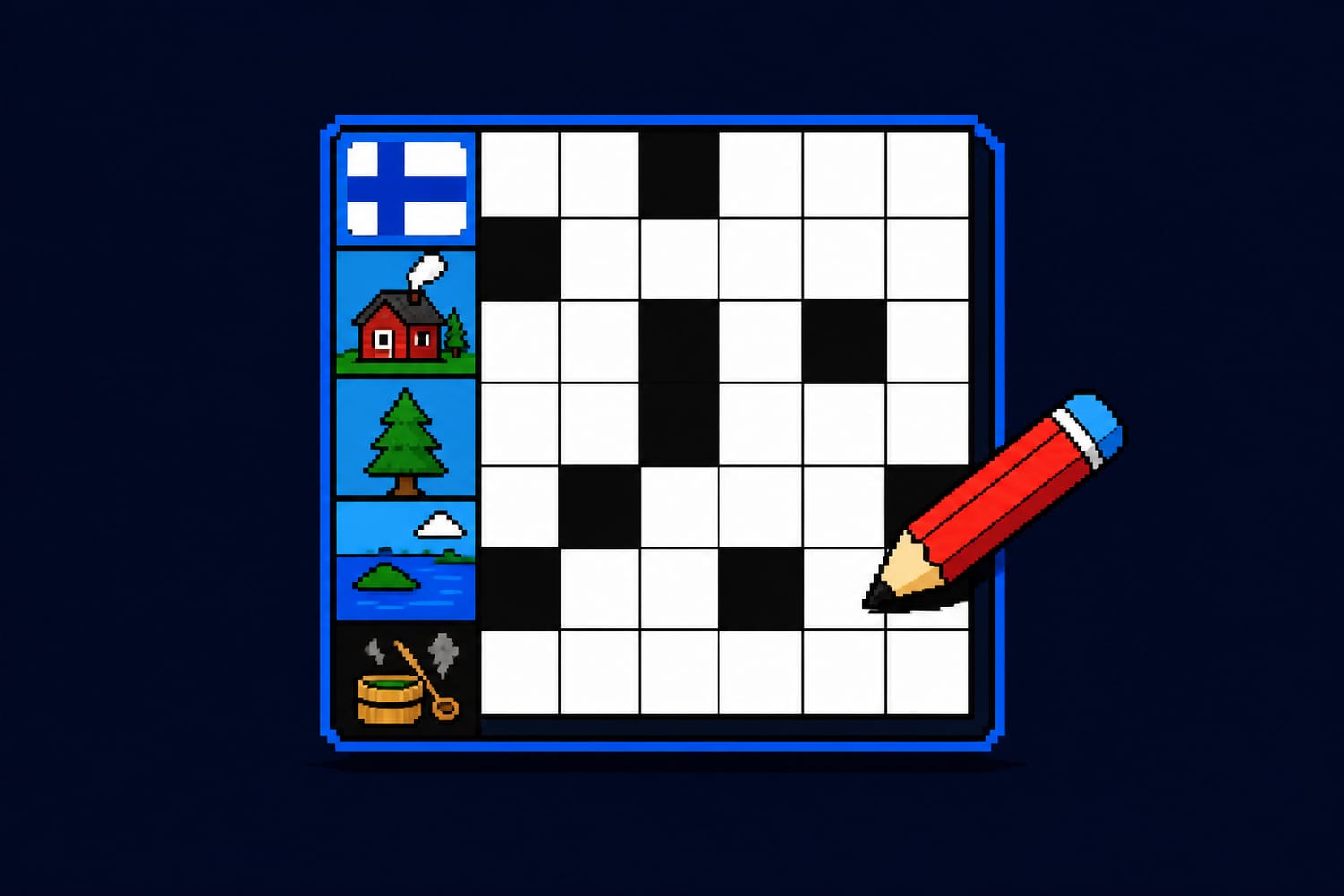
Finnish crosswords look different because Finland’s dominant crossword tradition is the picture crossword, or kuvaristikko. Instead of placing numbered clues in lists beside the grid, these puzzles put short clues, drawings and photographs directly inside it. Arrows show where each answer begins, creating a lively mixture of language puzzle, illustration and visual detective work.
To someone accustomed to an American or British crossword, the first encounter can be startling. There may be no numbered squares, no separate “Across” and “Down” sections and no symmetrical pattern of black blocks. A large cartoon might occupy the center, while tiny images and compact verbal clues fill spaces between the answers.
It may not resemble a familiar crossword page, but the essential idea remains unchanged: solve words and use their crossing letters to confirm one another.
The Basic Anatomy of a Finnish Picture Crossword
The Finnish word ristikko is commonly used for a crossword or crossword-like grid, while kuvaristikko refers more specifically to a picture crossword. The format belongs to the wider Scandinavian or Swedish-style crossword family, so it is not unique to Finland. However, Finnish publishers and constructors have made it a particularly prominent part of the country’s puzzle culture.
A typical Finnish picture crossword includes:
- Clues printed inside the grid, rather than in a numbered list
- Arrows showing the direction of each answer
- Small drawings or photographs used as individual clues
- A larger central image, often providing several clues
- Short text clues, including definitions, associations and wordplay
- An irregular layout designed around the pictures instead of symmetry
A clue cell may send an answer to the right, downward or occasionally in another clearly marked direction. Because several arrows can begin near the same image, the solver must first understand the puzzle’s visual map.
The absence of clue numbers changes the rhythm of solving. In a numbered crossword, you might move neatly from 1 Across to 2 Across. In a Finnish picture crossword, your eyes travel around the page, jumping between images, arrows, partially completed words and promising intersections.
From Imported Crossword to Finnish Institution
The modern crossword’s international rise began in the early 20th century, but national puzzle traditions soon developed their own rules and appearances. According to Finland’s Ristikkoakatemia, the first Finnish crossword was published in 1925, while the country’s first picture crossword appeared in 1955.
That 30-year gap is important. Finland did not simply receive a completed puzzle format and leave it unchanged. Constructors and publishers adapted the crossword into something better suited to illustrated magazines, family entertainment and visually varied puzzle pages.
By the second half of the 20th century, picture crosswords had become deeply established. A 2012 Yle feature on Finnish crossword culture reported that approximately 90 percent of the crosswords then published in Finland were picture crosswords. Although publishing habits continue to evolve, that figure demonstrates how thoroughly the illustrated style came to define the Finnish idea of a crossword.
The popularity is also visible in specialist magazines. Finnish newsstands have long carried publications devoted to crosswords at different difficulty levels, from relaxed beginner grids to demanding puzzles built around indirect clues and rare vocabulary.
For a wider look at the region’s enthusiasm for quiet, pencil-and-paper entertainment, explore Scandinavian puzzle culture and its cozy brain-game traditions.
Why Pictures Work So Well as Clues
A picture appears universal, but it is rarely as simple as it looks. A drawing of a pine tree might suggest tree, pine, forest, branch, needle, wood or even a place name associated with forests. The available spaces and crossing letters reveal which interpretation the constructor intended.
That makes a picture clue both accessible and wonderfully ambiguous. A child can recognize the object, while an experienced solver can enjoy the more difficult task of identifying the exact word required.
Pictures can operate in several ways:
- Direct identification: A drawing of a cat points to the Finnish word for cat.
- Part identification: An arrow highlights the animal’s paw, tail or whiskers.
- Associated idea: A sun might indicate heat, summer, light or daytime.
- Name recognition: A photograph may ask for a public figure’s first name or surname.
- Visual wordplay: The image may suggest a sound, expression or playful combination of ideas.
The larger central illustration is often the puzzle’s visual centerpiece. Lines or arrows may point toward particular people, objects or actions within the scene. A kitchen picture, for example, could produce answers for a spoon, cook, oven, steam and apron—all from different parts of one image.
This style rewards visual observation as much as vocabulary. Solvers are not merely reading definitions; they are deciding what matters inside a crowded little scene.
How Finnish Language Shapes the Challenge
Every crossword is influenced by its language. Finnish has grammatical and structural features that make its word puzzles feel different from English ones, just as explained in Puzzles Arcade’s guide to how language shapes word games around the world.
Finnish uses many suffixes to express meanings that English often communicates with separate words. It is also highly productive in forming compound words. These qualities give constructors a large supply of related word forms and precise vocabulary, although published crossword conventions determine which forms are considered fair or elegant.
Finnish also contains the letters ä and ö, which are independent letters rather than decorated versions of a and o. They are entered into individual squares just like any other letter. Vowel harmony, repeated vowels and doubled consonants create patterns that experienced Finnish solvers learn to recognize.
For learners, however, picture crosswords can be deceptive. The image may help identify a concept, but the solver still needs the correct Finnish word, spelling and form. A familiar object can have multiple names, including formal terms, everyday alternatives, dialect words and compounds.
This is one reason crossing letters are so important. You do not need to solve every clue immediately. Each confirmed answer turns neighboring mysteries into smaller, more manageable language problems.
How They Differ from American and British Crosswords
An American-style crossword generally places numbered clues outside a usually symmetrical grid. Most letters belong to both an Across and a Down answer, producing a tightly interconnected structure.
British crosswords often use a more open grid with fewer intersections. Their clues may be straightforward, but Britain is especially famous for cryptic crosswords, in which each clue contains structured wordplay.
Finnish picture crosswords shift attention in another direction:
| Feature | Finnish picture crossword | Typical American crossword | |---|---|---| | Clue location | Inside the grid | In lists outside the grid | | Navigation | Arrows | Numbers | | Images | Common and often central | Uncommon | | Symmetry | Usually not essential | Usually expected | | Visual design | Illustration-led | Grid-led | | Solving flow | Free movement around the page | Across and Down sequence |
These are traditions rather than absolute rules. Finland also publishes conventional word-clue crosswords, cryptic-style puzzles and many other varieties. Likewise, arrowwords and picture crosswords appear outside Finland.
The contrast shows that a crossword is not one fixed object. It is a flexible idea that cultures redesign according to local language, publishing customs and solving preferences. Readers interested in another comparison can examine the cultural differences between U.S. and UK crossword styles.
A Beginner’s Method for Solving One
A Finnish picture crossword becomes much less intimidating when approached in stages.
1. Start with unmistakable images
Look for clearly depicted animals, foods, tools and body parts. Avoid portraits or abstract scenes until crossing letters provide support.
2. Check every arrow
Confirm exactly where the answer starts and where it travels. The closest empty space is not always connected to the clue you are viewing.
3. Count the available squares
Answer length can separate several possible interpretations of the same image. Remember that ä and ö each occupy one square.
4. Use crossing letters aggressively
A guessed word is only a possibility until its letters agree with neighboring answers. Build outward from the entries you trust most.
5. Expect compact clues
Because clue cells are small, text may be abbreviated or highly economical. A single word can point to a synonym, category, person, place or association.
6. Return to the central illustration
Once the surrounding grid contains letters, the big picture’s harder clues often become much easier to interpret.
More Than Decoration
Pictures do not merely make Finnish crosswords attractive. They change the kind of thinking the puzzle demands.
The solver moves continuously between seeing and naming. A drawing must be converted into a concept, the concept into Finnish vocabulary and that vocabulary into a letter pattern that agrees with the rest of the grid. Even a tiny cartoon can create a chain of observation, interpretation and verification.
Finland’s organized crossword community reflects the seriousness behind the fun. Sanaristikkoseura Sanasepot brings together solvers and constructors, supports events and competitions and treats crosswords as part of Finnish verbal culture.
That combination of visual charm and linguistic precision explains the enduring appeal of the Finnish picture-clue tradition. What initially looks like a chaotic page of arrows and cartoons is actually a carefully engineered conversation between image and language.
Once you learn how to follow that conversation, the grid no longer looks strange. It looks inviting.

