
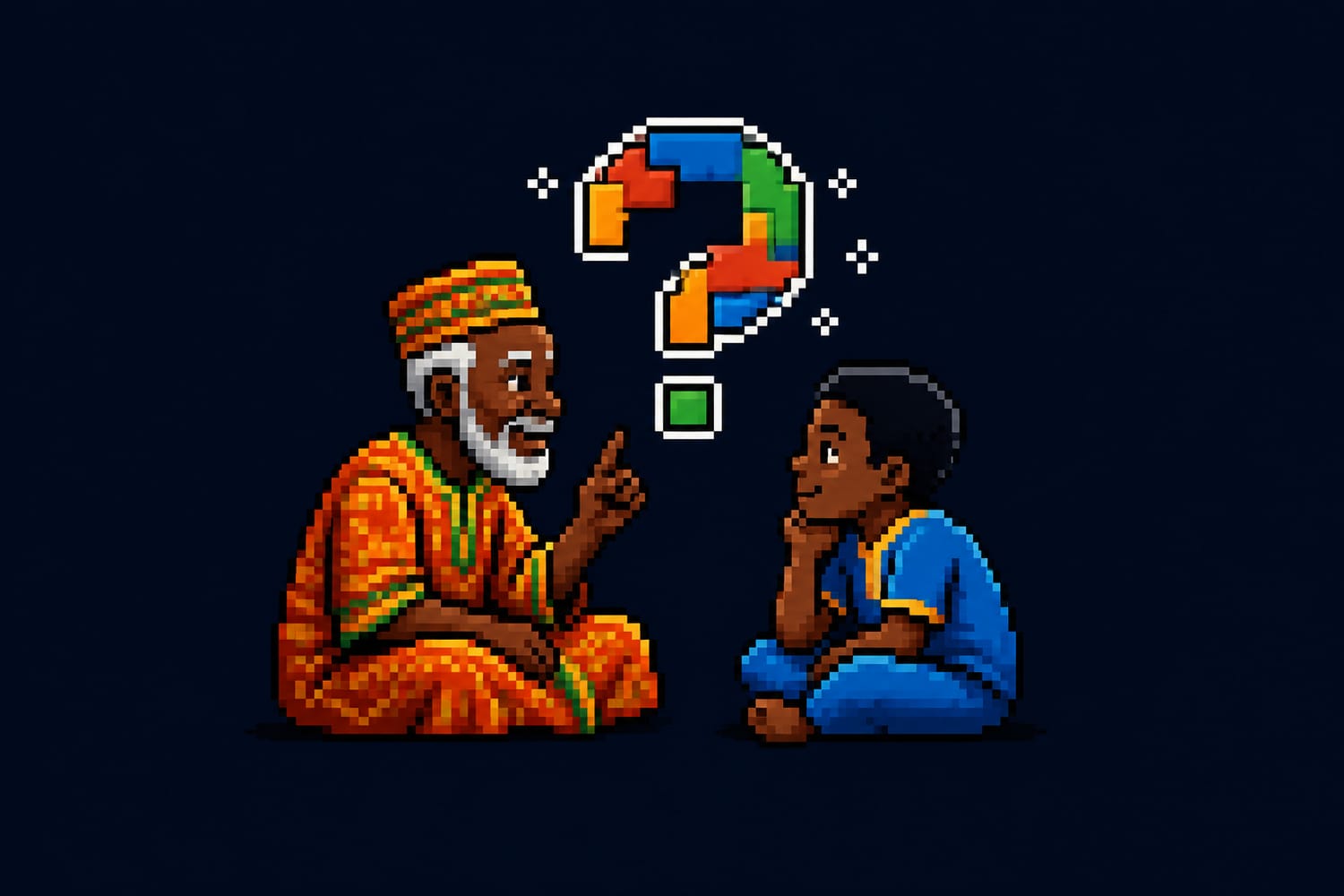
Riddles Across West Africa: How Wordplay Passes Wisdom Between Generations
A Puzzle That Carries More Than an Answer
Across West Africa, riddles have long combined entertainment with education. Shared aloud among children, relatives and neighbors, they sharpen observation, exercise memory and turn familiar objects into surprising mysteries. More importantly, riddles create conversations in which one generation can pass language, values and practical knowledge to the next.
West Africa is enormously diverse, so there is no single “West African riddle tradition.” Yoruba, Fulani, Hausa, Akan, Mandinka, Wolof and many other communities have their own languages, performance styles and conventions. Yet a shared principle appears again and again: wisdom becomes memorable when people must play with it.
The Riddle as a Living Puzzle
A written riddle sits quietly on a page. An oral riddle is an event.
One person presents the puzzle, perhaps changing their voice or repeating a rhythmic phrase. The listeners offer answers, defend their guesses and laugh at clever mistakes. When the solution is revealed, the group discusses how the clues fit.
That interaction is important. UNESCO includes riddles alongside proverbs, tales, songs and poems within the broad field of oral traditions and expressions. These traditions carry knowledge, social values and collective memory, but they are not usually repeated like recordings. Wording, rhythm and detail may change as people perform them in new places and circumstances.
This makes a riddle both old and new. Its central image may be inherited, while each speaker gives it fresh energy.
How West African Wordplay Works
English-language riddles often depend on spelling tricks, homophones or words with double meanings. Those devices can also appear in West African languages, but many traditional riddles are built primarily from images, comparisons and unexpected relationships.
Research into Fulani oral literature, for example, describes riddling as a play of ideas and images. The solver identifies the most important qualities in the clue and searches for something else that behaves or appears in the same way. Fulani verbal art also includes proverbs, epigrams, tongue-twisters and chain rhymes, showing how closely puzzling, poetry and wisdom can be connected.
A Yoruba riddle recorded in both Yoruba and English translation describes a tiny rod touching the earth and sky. The answer is rain: each falling drop appears to connect the two. Another describes a short old man wearing an iron garment, leading to the hard-shelled palm kernel.
These clues reward more than vocabulary. Solvers must ask:
- What object has this shape or movement?
- Which clue is literal, and which is metaphorical?
- What part of daily life would the original audience recognize?
- Is the speaker describing size, sound, color, behavior or purpose?
The result is a form of verbal pattern recognition. Much like a visual puzzle, the answer appears when separate clues suddenly become one picture.
Everyday Life Becomes the Puzzle Board
Traditional riddles often draw their imagery from the world close at hand. Depending on the community and period, that world might include rain, rivers, farm tools, cooking fires, animals, trees, woven objects, household utensils and parts of the human body.
This local imagery gives riddles educational value. A child cannot solve a comparison involving a palm kernel without knowing something about its appearance. A riddle about a bird’s call encourages careful listening. One about planting, pounding grain or carrying water may preserve words and observations connected to those activities.
Riddles therefore train attention. They invite young listeners to notice that rain resembles a line between sky and ground, that a broom is made from many strands acting as one, or that an object can sound different when struck, shaken or opened.
Readers interested in other ways language shapes puzzles can explore word games beyond the alphabet. Translation can carry a riddle’s basic meaning across borders, but sound patterns, tones, cultural associations and grammatical surprises may remain rooted in the original language.
What Children Learn While Guessing
A riddle session may feel like play, but several kinds of learning happen at once.
Language and memory
Short, patterned sentences are easier to remember than long explanations. Repetition strengthens vocabulary, while rhyme, alliteration and tonal effects help listeners recognize how their language can be shaped artistically.
Reasoning and flexible thinking
A solver must move beyond the first obvious interpretation. If “children” in a clue are actually teeth, seeds or broom strands, the listener learns that words can represent categories, relationships and resemblances.
Confidence in speaking
Guessing aloud requires courage. Children practice responding clearly, listening to others and sometimes explaining why their answer should be accepted. A wrong answer can still be admired if the reasoning is inventive.
Social knowledge
Riddles can contain lessons about cooperation, patience, pride, responsibility or the consequences of careless judgment. The lesson is rarely delivered as a lecture. Instead, it emerges from the answer and the conversation surrounding it.
This social form of problem-solving connects with the wider ways different cultures approach puzzles. The goal may not simply be to identify the fastest individual solver. Participation, humor, respectful competition and shared discovery can matter just as much.
Elders, Children and the Chain of Transmission
A riddle survives because someone remembers to ask it again. The process often follows a simple cycle:
- A younger listener hears the riddle performed.
- They attempt an answer and learn the accepted solution.
- An experienced speaker explains the comparison or hidden lesson.
- The listener remembers the wording and later presents it to others.
- The next audience repeats, adapts or debates it.
Older speakers contribute vocabulary, context and accumulated knowledge. Younger participants contribute new interpretations and may adapt familiar structures to modern objects. A riddle once centered on a cooking pot or village path might inspire a newer puzzle about a telephone, bus or electric light.
This does not mean that all oral knowledge is transmitted by elders alone. Children create, exchange and modify riddles among themselves, while siblings and friends can be important teachers. The tradition moves in several directions, even though experienced community members often provide historical and linguistic depth.
That combination of family learning and playful challenge also appears in other puzzle cultures that encourage children to become active problem-solvers.
Where Griots Fit—and Where They Do Not
Discussions of West African oral culture often mention griots, known by names such as jeli in Manding languages. These specialized historians, musicians, praise singers and orators preserve genealogies, narratives and other forms of cultural knowledge. Smithsonian Folkways describes griots as repositories of oral tradition and holds recordings from Gambia and Mali in Mandinka, Pulaar, Soninke and Wolof.
However, it would be misleading to say that every West African riddle comes from a griot. Many riddles belong to informal household, neighborhood or children’s play. Griot traditions are especially important in particular Mande and neighboring societies, while other communities organize oral performance differently.
The larger lesson is that West African verbal arts have many guardians. They include professional performers, parents, grandparents, teachers, storytellers, children and anyone who remembers the right question at the right moment.
Preserving Riddles Without Freezing Them
Recording and writing down riddles can help protect them from being forgotten, especially when a language has limited representation in books or online. Audio and video are particularly valuable because they can preserve pronunciation, tone, pacing and audience participation.
Yet preservation should not turn a living tradition into an anonymous list of “African riddles.” Responsible collecting should identify the language, community, speaker, location and context whenever permission allows. Translators should also explain cultural references rather than replacing them with more familiar foreign objects.
Families and classrooms can support living transmission by:
- Inviting relatives or community speakers to share riddles
- Recording original-language versions with permission
- Asking children to illustrate the answers
- Comparing several versions without declaring one automatically “correct”
- Encouraging learners to create new riddles from local surroundings
- Keeping the question-and-answer performance, not merely memorizing solutions
The Wisdom Inside the Game
The brilliance of a short riddle lies in how much it can hold. A few words may contain a lesson in observation, a miniature poem, a memory of daily work and an invitation for several generations to think together.
West African riddles remind us that education does not always begin with a book or a classroom. Sometimes it begins when one person asks an impossible-sounding question, another risks a guess, and everyone leans forward to discover how the ordinary world has been transformed by words.

