
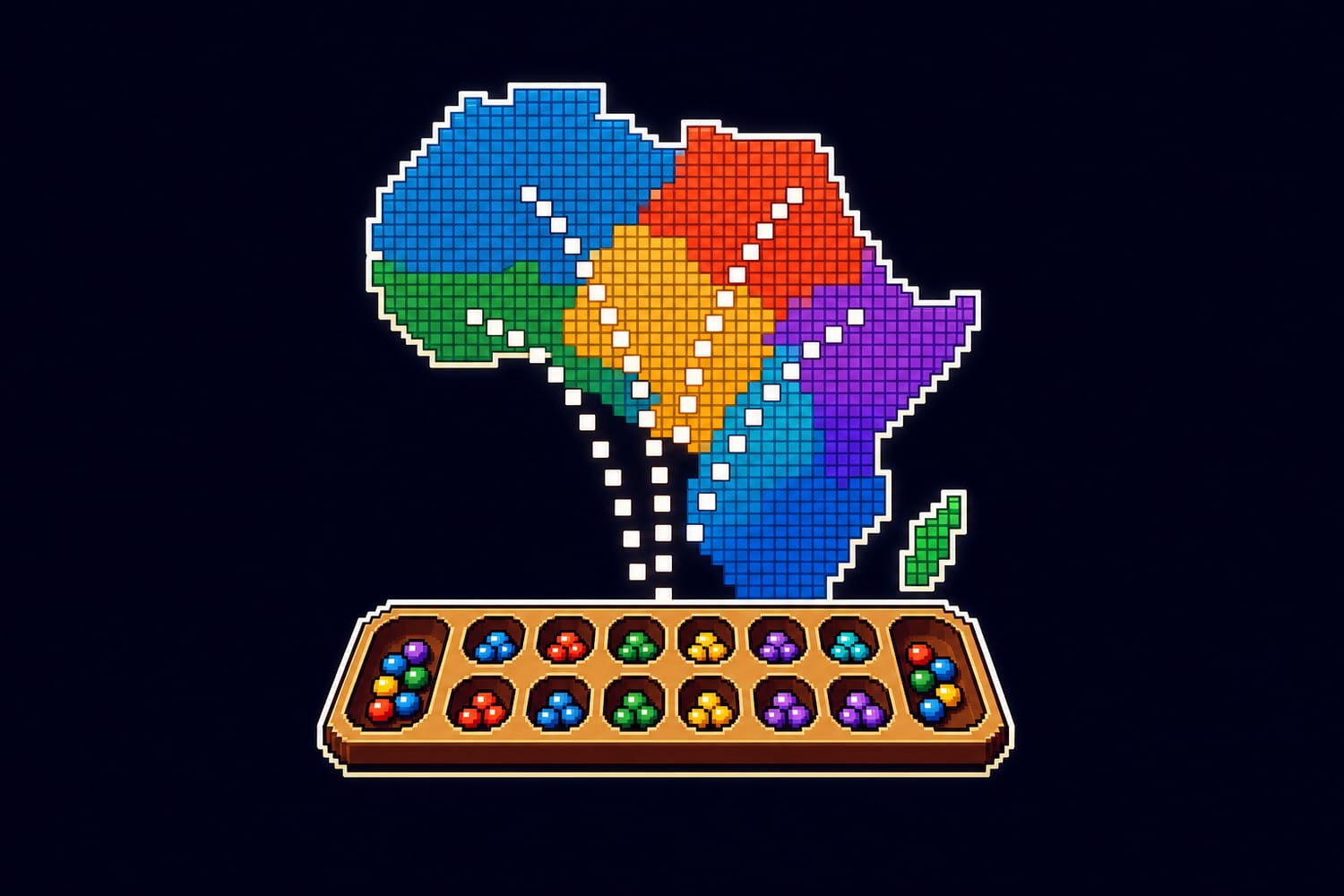
Mancala Across Africa: How One Game Family Became Hundreds of Local Traditions
One Name, a Whole Family of Games
Mancala is not one game with a single universal rulebook. It is a broad family of “sowing” or “count-and-capture” games in which players distribute seeds, stones, shells, or other counters among rows of pits. Across Africa, communities transformed this shared idea into hundreds of named games and local rule traditions.
That distinction matters. Calling every version simply “Mancala” is a little like calling chess, checkers, and backgammon “board game.” The label identifies a family, but it does not tell you exactly what people are playing.
Researchers have recorded hundreds of names and rule sets, although an exact total is difficult to establish. One name may describe several related games, while neighboring communities may use different names for nearly identical rules. Traditions can also change between towns, families, generations, and competitive groups.
The Simple Idea at Mancala’s Heart
Most Mancala games begin with an elegantly physical action: sowing. A player lifts all the counters from one pit and drops them, one at a time, into a sequence of other pits.
From that common beginning, the possibilities multiply. Depending on the game:
- Sowing may move clockwise or counterclockwise.
- A turn may stop after one circuit or continue through several relays.
- Captures may depend on the final pit containing a particular number of counters.
- Captured pieces may leave the board or return to the capturing player’s rows.
- Emptying an opponent’s side may be forbidden, encouraged, or part of winning.
- Players may control one row, two rows, or a special “house.”
- Victory may require capturing the most counters or leaving an opponent without a legal move.
The equipment is equally flexible. A board can be a carefully carved work of art, a row of hollows scooped into the earth, or circles drawn on paper. Beans, pebbles, shells, beads, and seeds can all become playing pieces. A Sierra Leonean board in the British Museum, for example, combines carved wood with cowrie shells and other counters.
Why One Game Family Became So Many Traditions
Mancala’s variety grew through movement and human contact. Trade, migration, intermarriage, conquest, and travel carried games between communities. Players adopted the basic mechanics, then adjusted them to match local preferences.
Rules were also commonly learned face-to-face. A child might watch older players, gradually understand legal moves, and later teach the game to someone else. In that process, small differences could become established traditions: a new opening arrangement, a different capture condition, or a special restriction intended to make play fairer.
The environment influenced the equipment as well. Where suitable wood and skilled carvers were available, boards could become decorated household or prestige objects. Elsewhere, players needed nothing more than a patch of sand and a handful of seeds.
This pattern appears throughout the wider history of play. Games cross borders, but they rarely remain unchanged. Readers interested in other examples can explore these global puzzle styles and regional variations.
A Tour of African Mancala Traditions
Africa’s Mancala map has no perfectly sharp borders, but several broad regional patterns help demonstrate the family’s remarkable range.
Oware and Ayo in West Africa
West Africa is especially associated with two-row games. Oware, also written as Awalé, Awari, Wari, and in several other forms, is closely connected with Ghana and is played under related names across much of West Africa and beyond.
A typical Oware board has two rows of six pits and begins with four seeds in each pit. Players sow counters around the board and generally capture from the opponent’s row when a final seed creates a group of two or three. However, feeding rules prevent a player from casually taking every available seed and leaving the opponent unable to continue.
In Nigeria, Ayo or Ayoayo belongs to the same broad two-row tradition but has its own rules and cultural setting. The Smithsonian’s Yoruba ayoayo gameboard illustrates how the board itself can combine strategy, craftsmanship, and identity.
These games can be learned quickly, but strong play requires counting, planning, and careful control of the opponent’s choices.
Bao on the Swahili Coast
Travel east and the boards often become larger and more complex. Bao, strongly associated with Tanzania, Zanzibar, Kenya, and the wider Swahili coast, commonly uses four rows of eight pits.
In the celebrated form called Bao la Kiswahili, each player controls two rows. The board includes specially marked pits known as houses, and play can involve an opening placement phase followed by a movement phase. Captures may trigger continued sowing, creating long sequences in which one decision transforms much of the board.
The result is a game of extraordinary depth. Even experienced players must track threats, forced moves, reserves, and possible chains of captures. A Kenyan Bao board documented by the Smithsonian shows the familiar four-row structure, including two distinctive square pits.
Omweso and Igisoro in the Great Lakes Region
Omweso is a major Ugandan tradition, while the closely related Igisoro is associated with Rwanda. Like Bao, these games normally use four rows, but sharing a board shape does not make them the same game.
Omweso typically begins with players arranging their counters across their own two rows. That setup is itself a strategic decision. Turns often use relay sowing: if a move finishes in an occupied pit, those counters may be lifted and sown again. Captures can therefore launch complicated sequences that reward mental calculation and pattern recognition.
Four-row games such as Bao and Omweso have attracted mathematical and computing research because their branching possibilities can be enormous. They are excellent examples of the hidden mathematics behind puzzle games, where arithmetic, memory, prediction, and logic work together.
From the Horn of Africa to the South
In Ethiopia and Eritrea, names such as Gebeta refer to several related pit-and-counter traditions rather than one standardized ruleset. Farther south and southwest, games include Nsolo in parts of Zambia and Malawi, Tsoro in Zimbabwe, Mefuvha in southern Africa, and ǁHus in Namibia.
These names should not be treated as simple translations of “Mancala.” Each belongs to particular communities, languages, and playing traditions. Board dimensions, opening positions, sowing directions, and capture systems can all differ.
More Than a Contest of Counting
Mancala boards are practical tools, but they can also be sculptures, social objects, and records of craftsmanship. Some feature animal forms, geometric decoration, raised supports, storage compartments, or handles. Others are worn smooth by years of play.
Games can bring generations together, provide a setting for conversation, or give skilled players a public arena in which to demonstrate memory and foresight. Learning may happen through observation as much as formal explanation. A beginner sees a move, asks why it worked, and slowly discovers the logic beneath it.
This is why traditional games deserve to be understood within their cultures rather than reduced to museum curiosities. Like many puzzles and games rooted in community life, their meaning can extend beyond winning and losing.
An Ancient Family with an Uncertain Starting Point
Mancala games are often described as thousands of years old, but precise origin stories should be approached cautiously. Archaeologists have found rows of cup-shaped depressions at ancient sites, yet similar holes could have served many purposes. A board-like pattern does not preserve its rules, name, or date of play.
What can be stated confidently is that count-and-capture games have a long history across Africa and are also found in the Middle East, Asia, the Caribbean, and parts of South America. The Arabic root associated with the word mancala relates to moving or transferring—an appropriate description of sowing counters from pit to pit.
African captives also carried game traditions across the Atlantic during the era of the slave trade. Related games survived in the Caribbean and the Americas under names including Warri and other local forms, preserving familiar mechanics while developing in new cultural environments.
A Family That Is Still Growing
Mancala’s story is not simply one ancient game spreading unchanged across a continent. It is the story of communities repeatedly reshaping a powerful idea.
A few pits and counters can produce fast games for beginners, long strategic battles between experts, social traditions, mathematical challenges, and beautiful works of art. From Oware in West Africa to Bao on the Swahili coast and Omweso in Uganda, each tradition offers a different answer to the same inviting question:
What can happen when we pick up a handful of seeds and begin to sow?

