
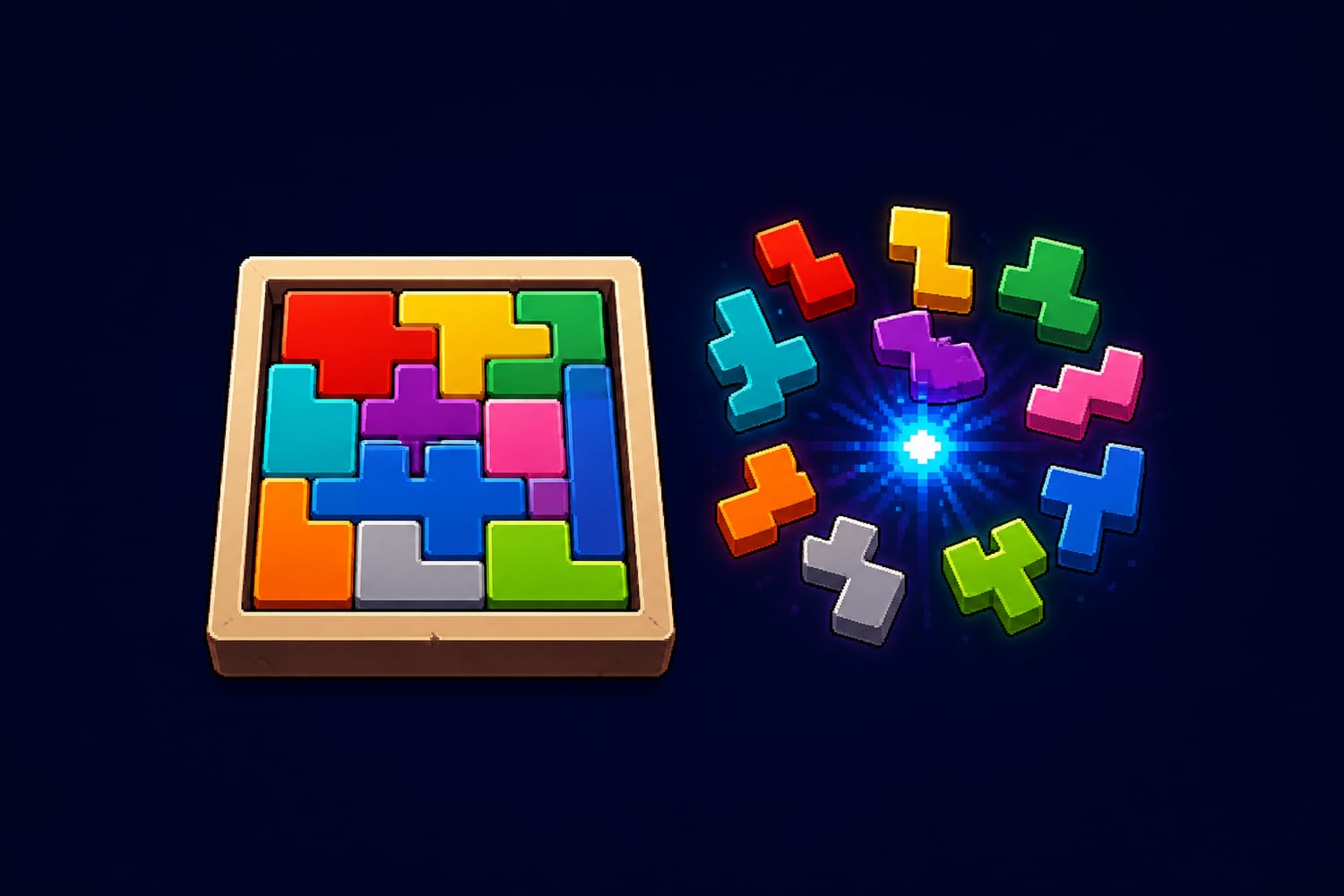
The Stomachion: How an Ancient 14-Piece Puzzle Hid 17,152 Solutions
A Square With Thousands of Secrets
The Stomachion is an ancient dissection puzzle made from 14 polygonal pieces. All the pieces fit together to form a square—but not in just one way. Modern researchers found 536 essentially different square arrangements, or 17,152 solutions when rotations, reflections, and exchanges of matching pieces are counted separately.
That is an astonishing amount of variety inside one small box. Even more remarkably, surviving evidence suggests that Archimedes may have studied the puzzle as a problem of systematic counting more than 2,000 years before combinatorics became a recognized branch of mathematics.
The result is a puzzle that connects ancient recreation, geometry, historical detective work, and modern computing.
What Is the Stomachion?
The Stomachion consists of 14 flat pieces cut from a square. Depending on the reconstruction, the collection contains triangles, quadrilaterals, and a five-sided polygon. The pieces can be rearranged to rebuild the square or create pictures of animals, people, ships, and other objects.
In that sense, it resembles the better-known seven-piece tangram puzzle. However, the Stomachion has twice as many pieces, more varied angles, and a dramatically larger number of square solutions.
Ancient Latin writers called it the loculus Archimedius, or “Archimedes’ box.” Its Greek name comes from a root connected with the stomach, although the precise reason for the name remains uncertain. It may have jokingly suggested a puzzle difficult enough to cause discomfort, but historians cannot confirm one simple translation.
Surviving descriptions mention pieces made from materials such as ivory. Like many modern puzzle sets, they could be stored together in a square frame and then removed for play.
Did Archimedes Invent It?
The Stomachion is closely associated with Archimedes, the Greek mathematician who lived in Syracuse during the third century BCE. He made major contributions to geometry, mechanics, hydrostatics, and the study of circles, spheres, and curved surfaces.
However, it would be inaccurate to say with certainty that he invented the puzzle. Ancient references suggest that some form of the game may already have been known. Archimedes was more likely investigating its geometry and the relationships among its possible arrangements.
Part of his work appears to have concerned the areas and angles of the pieces. In a modern reconstruction, the square can be placed over a 12-by-12 grid, giving it a total area of 144 units. The 14 pieces have different areas, but every one occupies an exact fraction of the whole.
The NYU reconstruction of the Stomachion’s geometry shows how lines between grid points produce the complete set of polygons. The smallest pieces have an area of three square units, while the largest has an area of 24. Together, of course, all 14 must total 144.
This area information gives solvers an important clue. A piece may look as though it belongs in a particular space, but matching the outline is not enough—the remaining pieces must still have exactly the right combined area and edge lengths to fill everything else.
The Manuscript That Was Erased and Reused
Much of what we know about Archimedes’ investigation survived through one of history’s most extraordinary manuscripts: the Archimedes Palimpsest.
A copy of several works by Archimedes was produced in the Byzantine world around the tenth century. In the 13th century, its parchment pages were taken apart, scraped, folded, and reused to make a Christian prayer book. The prayers remained visible, while the older mathematical writing became a faint layer underneath.
A manuscript created in this way is called a palimpsest. Parchment was valuable, so recycling old books was not unusual. Unfortunately, it also meant that important texts could disappear beneath newer writing.
In 1906, Danish scholar Johan Ludvig Heiberg examined the prayer book in Constantinople and recognized works by Archimedes beneath the visible text. He photographed many pages and attempted to read the hidden writing, but parts of the Stomachion remained extremely difficult to understand.
The book later disappeared from scholarly view before resurfacing and being sold at auction in New York on October 29, 1998. Its new owner placed it with the Walters Art Museum in Baltimore, where specialists conserved and photographed it using advanced imaging techniques. Different wavelengths of light helped distinguish the erased ink from stains, damage, and the later prayers.
The official history of the Archimedes Palimpsest reads almost like an archaeological mystery. Without the manuscript’s survival—and the technology used to study it—the deeper purpose of the Stomachion might still be unknown.
From Geometry to Combinatorics
For many years, scholars assumed that the Stomachion was mainly a picture-making game. That interpretation made sense: ancient writers described figures created with the pieces, just as tangram players make cats, dancers, boats, and birds.
Closer examination of the surviving text suggested a more ambitious possibility. Archimedes may have been interested in how one valid square arrangement could be transformed into another by moving, exchanging, rotating, or reflecting pieces.
That makes the puzzle a problem in combinatorics, the mathematics of counting possible arrangements.
Combinatorics asks questions such as:
- How many valid arrangements exist?
- When should two arrangements be considered equivalent?
- How can we be sure that none have been missed?
- Can a large search be divided into smaller, manageable cases?
- How can symmetry prevent us from counting the same pattern repeatedly?
These questions also appear in the Eight Queens Puzzle and its 92 solutions. In both puzzles, the final number depends partly on whether rotated and reflected arrangements are treated as new solutions or as versions of the same fundamental pattern.
Why the Answer Is Both 536 and 17,152
The number in the title requires an important explanation.
Modern researchers found 536 geometrically distinct solutions for assembling the 14 pieces into a square. These are the fundamentally different tilings after equivalent forms are grouped together.
The larger total is calculated as:
536 × 32 = 17,152
Where does the factor of 32 come from?
A completed square can be viewed in eight orientations: four rotations, with reflected versions of each. In addition, the Stomachion contains two pairs of pieces that have matching shapes. If those individual pieces are treated as separately labeled objects, the members of each pair can exchange places.
That produces four labeling possibilities for every geometric orientation:
8 orientations × 4 exchanges = 32
Therefore:
- 536 counts the essentially different geometric square designs.
- 17,152 counts the expanded arrangements when symmetries and exchanges of matching pieces are distinguished.
Neither number is “wrong.” They answer slightly different versions of the question. The official Archimedes Palimpsest discussion of the Stomachion uses the larger total while identifying the 536 geometrically distinct solutions beneath it.
How Modern Solvers Found Every Arrangement
Finding one Stomachion square is a satisfying hands-on challenge. Finding every possible square is a completely different task.
A person working manually might discover several arrangements, but proving that the list is complete requires a systematic method. Modern investigators approached the puzzle with both mathematical reasoning and computer search.
A computer can represent the square as a grid and generate legal positions for each piece. It places one piece, tests the remaining space, and continues only when the partial arrangement can still lead to a complete square. If a gap cannot possibly be filled, the program abandons that branch and returns to an earlier decision.
This process is called backtracking:
- Place a piece in a legal position.
- Choose another piece and test possible placements.
- Reject overlaps, gaps, and impossible boundaries.
- Continue until the square is complete.
- Record the solution.
- Back up and test the next possibility.
Computer scientist Bill Cutler conducted an exhaustive search, while mathematicians Persi Diaconis, Susan Holmes, Fan Chung, and Ronald Graham investigated the counting and symmetries. Their work converged on the same remarkable result.
This combination of human insight and mechanical checking is common in recreational mathematics. Computers explore enormous numbers of cases, while people determine the rules, identify equivalent solutions, and explain why the result makes sense.
How to Try the Stomachion Yourself
You do not need to search for all 536 fundamental squares to appreciate the puzzle. A paper or cardboard set is enough to begin.
For a rewarding first challenge:
- Mix all 14 pieces thoroughly.
- Try to rebuild a square without viewing the original layout.
- Keep edges flat against the boundary whenever possible.
- Watch for tiny gaps, which often reveal an incorrect angle.
- Photograph each successful arrangement before trying another.
- Compare new squares carefully to see whether they are only rotations or reflections of earlier ones.
You can also use the pieces creatively to construct animals and objects. This changes the task from exact tiling to geometric imagination and demonstrates why the puzzle could function as both a game and a serious mathematical investigation.
Patience matters. With 14 pieces, an early placement can appear correct but make completion impossible several moves later. That same delayed consequence makes puzzles such as the Knight’s Tour so challenging.
Why This Ancient Feat Still Matters
The Stomachion is much more than an old set of shapes. It shows that a simple physical puzzle can contain questions about area, symmetry, classification, algorithms, and proof.
It also changes how we imagine ancient mathematics. Archimedes was not limited to measuring curves or studying machines. The surviving evidence indicates that he may also have explored how possibilities could be organized and counted—a style of thinking central to modern probability, optimization, and computer science.
We do not know whether Archimedes calculated the number 17,152 himself. Too little of his text survives to make that claim. What we can say is that he recognized something extraordinary inside the square: one arrangement was only the beginning.
Fourteen pieces, 536 fundamental tilings, and 17,152 expanded solutions make the Stomachion an amazing feat of both ancient curiosity and modern problem-solving. More than two millennia after Archimedes studied it, the puzzle continues to ask the same irresistible question: how much possibility can be hidden inside a square?

