
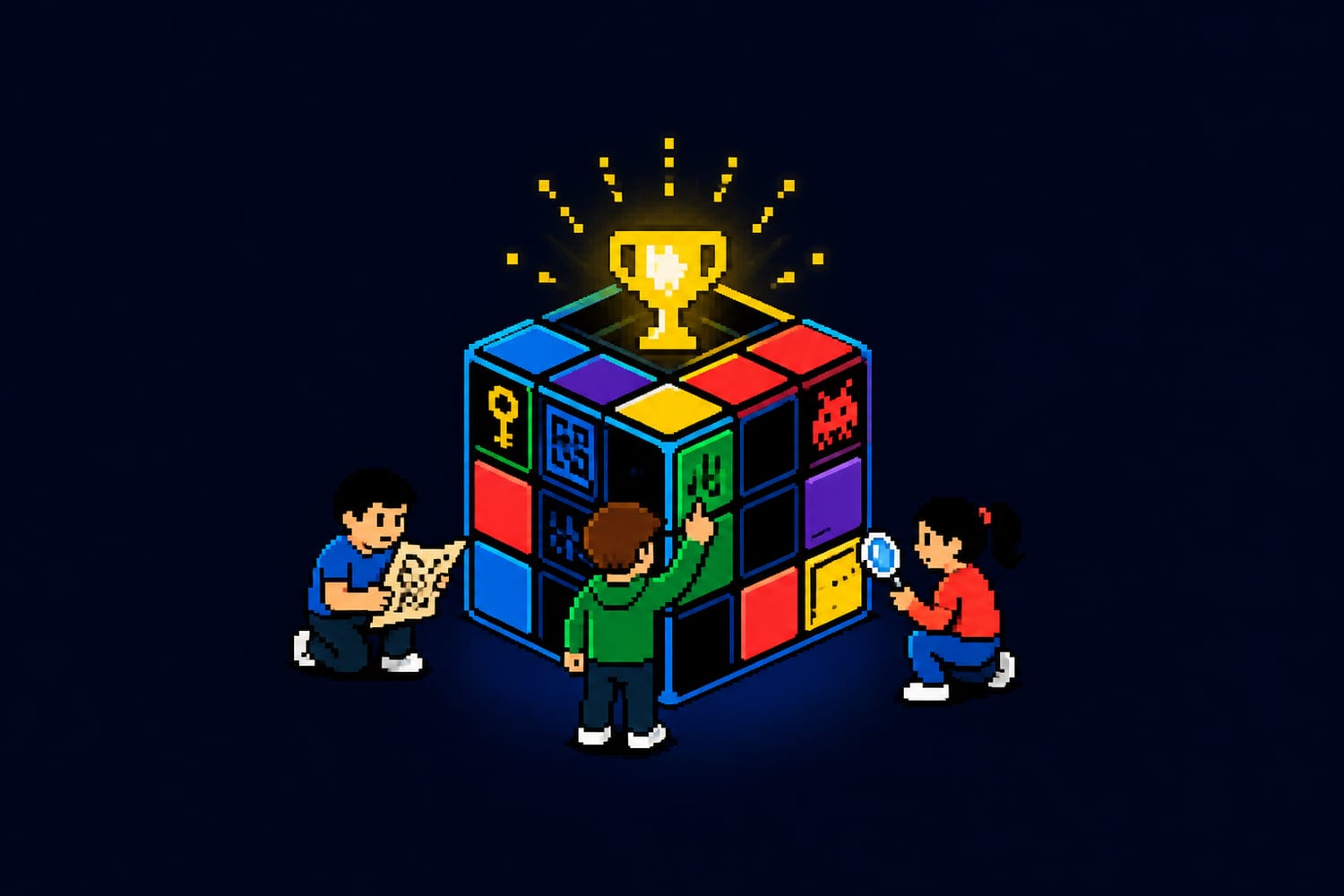
The MIT Mystery Hunt: How Teams Crack Hundreds of Puzzles in One Weekend
A Weekend Where Puzzles Take Over MIT
Every January, while many people are easing into the new year, one of the world’s most legendary puzzle events begins at the Massachusetts Institute of Technology: the MIT Mystery Hunt. For an entire weekend, teams of solvers race through an enormous collection of puzzles, codes, word games, logic challenges, scavenger tasks, hidden patterns, and surprising physical or digital experiences.
The goal is simple to describe but incredibly difficult to achieve: solve enough puzzles to find a hidden “coin” somewhere on or around the MIT campus. In practice, that simple goal turns into a marathon of creativity, teamwork, caffeine, spreadsheets, and “aha!” moments.
The MIT Mystery Hunt began in 1981, created by Brad Schaefer, and it has grown into one of the most famous puzzlehunts in the world. It traditionally takes place over Martin Luther King Jr. Day weekend in January. Teams range from small groups of friends to huge organizations with dozens or even hundreds of members, including students, alumni, puzzle fans, families, and remote participants.
What makes the event especially unusual is that the winning team does not just receive glory. It earns the responsibility of writing the next year’s Hunt. That means every MIT Mystery Hunt is created by a different group of puzzle lovers, giving each year its own theme, structure, style, and personality.
What Is a Puzzlehunt?
A puzzlehunt is not quite like a crossword tournament, an escape room, or a trivia contest, though it may borrow ideas from all of them. In a puzzlehunt, teams receive many puzzles, usually without direct instructions. A puzzle might look like a list of strange phrases, a grid of numbers, a set of pictures, a song, a website, a video, a board game, or even a physical object.
The challenge is not just to answer the puzzle. First, solvers must figure out what kind of puzzle it is.
For example, a page might show twelve movie titles, but the real trick could involve the actors’ initials. A set of numbers might not be math at all, but map coordinates. A poem might hide a message using the first letter of every line. A crossword might contain unusual answers that point to a second layer of meaning.
Most Mystery Hunt puzzles eventually produce an answer: usually a word or short phrase. That answer is entered into the Hunt system and checked. If it is correct, the team may unlock more puzzles.
Puzzlehunts reward curiosity. The best solvers are not always the people who know the most facts. Often, they are the people who ask the best questions: “Why are there exactly 26 items?” “Why is this word misspelled?” “Why are these colors in this order?” “What does this remind me of?”
Why the MIT Mystery Hunt Is So Famous
The MIT Mystery Hunt is famous because of its scale, creativity, and tradition. Many puzzle events last a few hours. Mystery Hunt lasts several days. Many puzzle events include a handful of puzzles. Mystery Hunt commonly includes a very large set of puzzles, often well over a hundred individual puzzles and meta-puzzles, depending on the year.
It is also known for its ambition. Puzzle constructors often spend months designing the event. The Hunt may include elaborate websites, original music, physical props, interactive games, live events, theatrical performances, or campus-based challenges. Some years have had themes inspired by stories, fictional worlds, games, time travel, museums, dreams, or other imaginative frameworks.
The event also has a special culture. Teams often set up headquarters in classrooms or online workspaces. Whiteboards fill with notes. Shared documents grow to hundreds of lines. Someone might be decoding Morse code in one corner while another person is identifying birds, solving a cryptogram, researching old video games, or building a paper model.
And somewhere beneath all of that activity is the larger structure of the Hunt. Individual puzzle answers feed into bigger puzzles called “metas.” Meta-puzzles are one of the defining features of modern puzzlehunts.
The Magic of Meta-Puzzles
A meta-puzzle, often just called a “meta,” uses the answers from several other puzzles as its ingredients. Imagine solving ten puzzles and getting ten answers: ORANGE, CLOCK, RIVER, BUTTON, PLANET, and so on. At first, they may seem unrelated. But a meta might reveal that each answer pairs with a word, fits into a pattern, or contributes letters to a final phrase.
Metas are exciting because they give the Hunt structure. They turn many separate puzzles into a connected adventure. A team may solve individual puzzles for hours, then suddenly realize that the answers all point toward a hidden message. That discovery can unlock a new round, reveal story progress, or bring the team closer to the final coin.
The best metas feel like a magic trick. All the pieces were visible the whole time, but only after the right insight does the pattern become clear. This is one reason people love Mystery Hunt: it creates moments of shared surprise. A room full of tired solvers can go from silence to cheering in seconds.
Metas also encourage teamwork. One person may solve a puzzle alone, but a meta often requires everyone’s answers, observations, and theories. It is common for teams to hold “meta meetings,” where solvers gather around a spreadsheet and try to connect the dots.
How Teams Organize the Chaos
Solving a giant puzzlehunt is not just about intelligence. It is about organization.
Large Mystery Hunt teams often use shared spreadsheets to track puzzle titles, answers, guesses, solving progress, and who is working on what. They may have chat channels for each puzzle, voice calls for brainstorming, and leaders who help direct attention toward important bottlenecks.
A puzzle might be marked as “new,” “in progress,” “stuck,” “needs extraction,” or “solved.” “Extraction” is a common puzzlehunt term meaning the final step that turns discovered information into the answer. For example, after identifying a set of songs, solvers might need to take the first letters of the artists’ names, index into the lyrics, or arrange the songs by release date.
Strong teams balance different types of solvers. Some people are fast at wordplay. Others know music, sports, history, science, movies, programming, languages, or math. Some are excellent at researching. Some are great at noticing visual details. Some keep morale high and make sure people take breaks.
A famous feature of Mystery Hunt is that nobody can solve everything alone. The event is too large and too varied. That is part of the fun. It turns puzzle-solving into a community sport.
The Many Kinds of Puzzles You Might See
One of the joys of the MIT Mystery Hunt is variety. A puzzle may use almost any subject or format, as long as it is fair and solvable.
Common types include:
- Word puzzles, such as anagrams, hidden messages, crosswords, acrostics, and letter patterns.
- Logic puzzles, involving grids, constraints, deduction, or mathematical reasoning.
- Codes and ciphers, such as Caesar shifts, Morse code, Braille, binary, semaphore, or custom encodings.
- Trivia and research puzzles, where solvers identify people, places, songs, books, films, artworks, or historical events.
- Physical puzzles, involving paper folding, cutting, construction, objects, or campus locations.
- Audio and visual puzzles, using sound clips, images, colors, maps, videos, or symbols.
- Interactive puzzles, including games, websites, performances, or tasks that change based on solver input.
However, Mystery Hunt puzzles are usually not just trivia quizzes. Even when a puzzle involves knowledge, the information is typically part of a larger pattern. A solver may need to identify twenty famous scientists, then sort them by birth year, take letters from their names, and decode the result.
This layered style is what makes puzzlehunts so satisfying. Each step reveals another step, and each discovery feels earned.
The “Aha!” Moment
Puzzle solvers often talk about the “aha!” moment. This is the instant when confusion turns into understanding. A strange list suddenly becomes a map. A group of unrelated images turns out to represent song titles. A weird number sequence becomes alphabet positions. A silly title becomes a clue to the entire mechanism.
Mystery Hunt is built around these moments. The puzzles are meant to be challenging, but they are also meant to be fair. A good puzzle gives solvers enough clues to find the path, even if that path is hidden at first. The answer should feel surprising but not random.
Constructors use titles, flavor text, formatting, and puzzle structure to guide solvers. “Flavor text” is the small introduction or story attached to a puzzle. It may seem decorative, but experienced solvers know it often contains hints. If a puzzle says something like “take a closer look at the stars,” it may be pointing toward astronomy, celebrity names, star ratings, or even asterisks.
The “aha!” moment is also why getting stuck is not failure. Being stuck is part of the process. Solvers test ideas, reject them, gather more information, and wait for the right connection to appear.
Finding the Coin
The final objective of the MIT Mystery Hunt is to find a hidden coin. This coin is not just a token prize; it is the symbolic heart of the event. The Hunt is sometimes described as a race to solve the final puzzle that reveals the coin’s location.
The exact ending changes from year to year. Teams may need to solve final meta-puzzles, complete interactions, follow clues around campus, or assemble information gathered throughout the Hunt. The winning team is the first to finish the final challenge and locate the coin.
Then comes the twist: the winners must create the next Mystery Hunt. This tradition keeps the event fresh and community-driven. It also means the winners go from solvers to constructors, taking on a huge creative and logistical project.
Writing a Hunt is an amazing feat in itself. Constructors must design puzzles, test them, build websites, create hint systems, manage story elements, coordinate events, and ensure the experience is challenging but enjoyable. A Hunt must be difficult enough for expert teams, but fair enough that progress is possible.
Why People Keep Coming Back
The MIT Mystery Hunt is exhausting. It can involve long hours, difficult puzzles, and moments of total bewilderment. So why do people return year after year?
Because it is also joyful.
It offers the thrill of discovery, the warmth of teamwork, and the pleasure of learning strange new things. During one Hunt, a solver might learn about classical composers, subway systems, mythical creatures, computer science, baseball statistics, poetry forms, and sandwich ingredients—all in the same weekend.
It also welcomes many different skills. You do not need to be a genius mathematician to contribute. If you can notice patterns, search carefully, think creatively, or explain your ideas clearly, you can help. Even beginners can spot something that experienced solvers miss.
Mystery Hunt shows that puzzles are not just tests. They are invitations. They invite us to look closer, think differently, and work together.
The Amazing Feat Behind the Fun
The MIT Mystery Hunt is one of the great celebrations of puzzle culture. It combines art, logic, storytelling, technology, and community into a single weekend-long adventure. Teams crack puzzle after puzzle not through magic, but through cooperation, persistence, organization, and creative thinking.
That is what makes the Hunt so inspiring. It proves that even the most impossible-looking challenges can be broken into smaller pieces. One clue leads to another. One answer unlocks a new path. One person’s observation becomes the key for the whole team.
Whether you are an expert solver or someone who simply enjoys a good riddle, the lesson of Mystery Hunt is wonderfully universal: stay curious, share what you notice, and never underestimate the power of a well-timed “aha!”

