
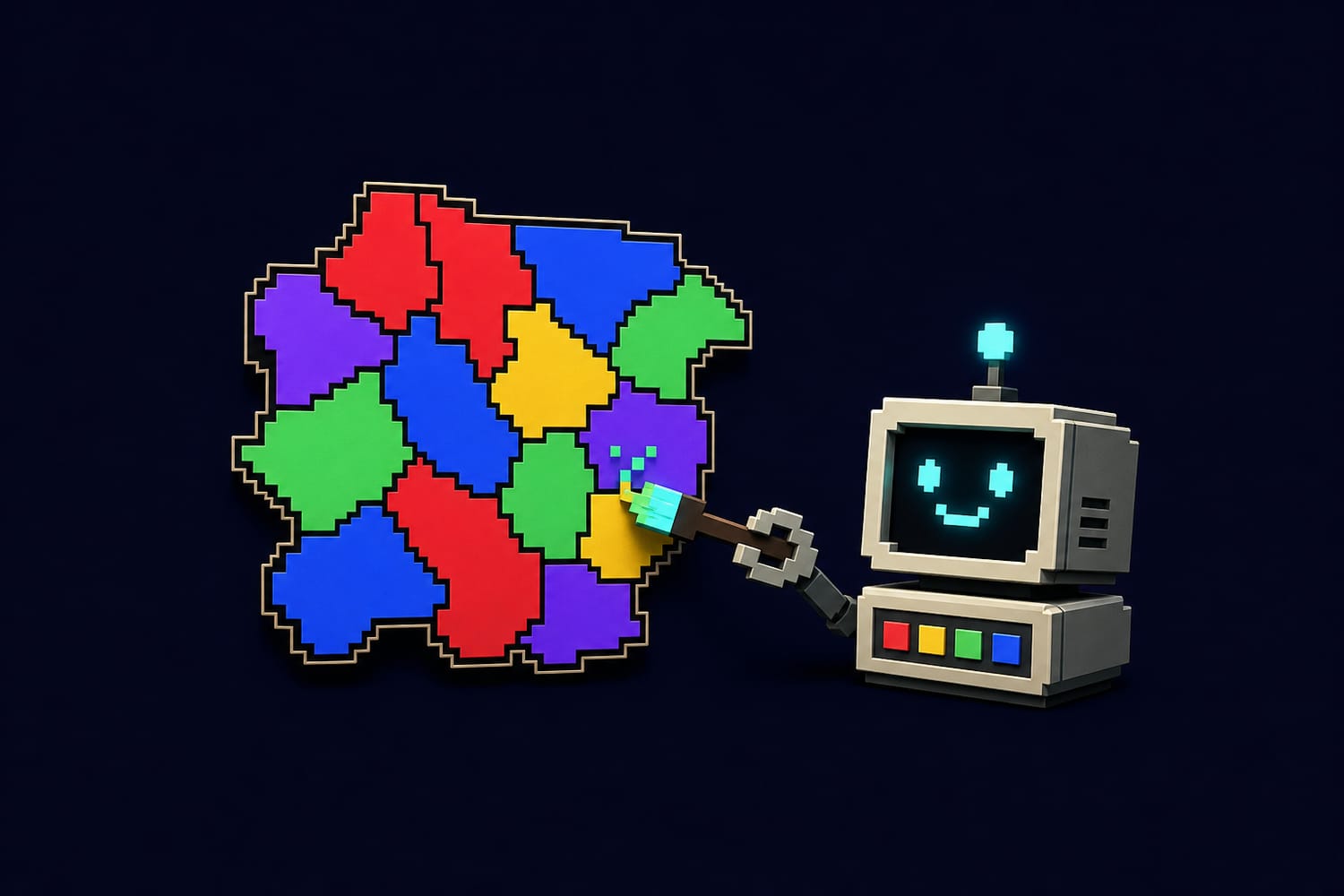
The Map-Coloring Puzzle That Took 124 Years—and a Computer—to Solve
A Puzzle Hidden in Every Map
Imagine you are coloring a map of countries, states, islands, or imaginary kingdoms. The rule is simple: any two regions that share a border must have different colors. If two regions only touch at a single point—like the corners of four states meeting—that does not count as sharing a border.
Now comes the puzzle:
How many colors do you need to color any map, no matter how complicated, so that neighboring regions never match?
At first, you might guess five, six, or even more. After all, maps can be messy. Borders twist and curl. Countries can wrap around lakes. Territories can form strange shapes. But one of the most surprising discoveries in mathematics is this:
Four colors are always enough.
This fact is known as the Four Color Theorem, and it is one of the most famous results in the history of mathematics. It sounds like a puzzle you might solve in an afternoon with crayons and patience. Instead, it took 124 years from the time it was first proposed to the time it was finally proved—and the proof required a computer.
That made it not only a great mathematical achievement, but also a turning point in how people thought about computers, logic, and proof itself.
The Simple Question That Started Everything
The story begins in 1852 with a young mathematician named Francis Guthrie. While coloring a map of the counties of England, Guthrie noticed something interesting: he seemed to need no more than four colors to make sure neighboring counties were different.
He wondered if this was always true. Could every possible map be colored with just four colors?
Francis shared the question with his brother, Frederick Guthrie, who passed it along to the famous mathematician Augustus De Morgan. From there, the problem spread through the mathematical world.
At first, the question seemed almost too simple. Anyone could understand it. You did not need advanced algebra or calculus to see what was being asked. Just draw a map and try to color it.
But that simplicity was deceptive.
Mathematicians quickly realized that proving the claim for every possible map was far harder than testing a few examples. A map can have any number of regions. Borders can be drawn in endlessly complicated ways. A proof had to work not only for maps that already existed, but for every map anyone could ever imagine.
That is what makes the Four Color Theorem such a wonderful puzzle: the rules are easy enough for a child to understand, but the solution challenged experts for more than a century.
What Counts as a Map?
To understand the theorem, it helps to be precise about what mathematicians mean by a “map.”
In everyday life, a map might show countries, roads, mountains, rivers, or oceans. In the Four Color Theorem, the focus is on dividing a flat surface into connected regions. Two regions are considered neighbors if they share a stretch of boundary, not just a single point.
For example, if four regions meet at one corner, like slices touching at the center of a pizza, they do not all need different colors just because they meet at that point. Only regions sharing an actual edge must be colored differently.
Mathematicians often translate map-coloring problems into something called a graph. In this graph, each region becomes a dot, called a vertex. If two regions share a border, the corresponding dots are connected by a line, called an edge.
This turns the map into a network. The Four Color Theorem then becomes a statement about planar graphs—graphs that can be drawn on a flat plane without edges crossing.
In graph form, the theorem says:
Every planar graph can have its vertices colored with no more than four colors so that connected vertices have different colors.
That may sound more abstract, but it is really the same puzzle in a different costume.
Why Not Three Colors?
If four colors always work, you might wonder: could three colors be enough?
Sometimes, yes. Many simple maps can be colored with only two or three colors. A checkerboard-like map only needs two colors. Some maps with a few regions can be done easily with three.
But three colors do not always work.
Imagine one central region surrounded by three regions that all touch the center and also touch each other in a cycle. The three outer regions may force three different colors, and then the center needs a fourth color because it touches all three of them.
This shows that four colors are sometimes necessary. The theorem does not say every map needs four colors. It says four colors are enough for every map, and some maps really do require all four.
That distinction is important. The Four Color Theorem is not about finding the fewest colors for one specific map. It is about proving a universal limit: no map on a flat surface can force you to use five.
False Starts and a Famous Mistake
The Four Color Problem attracted many mathematicians during the 1800s. Because the question was so easy to state, many people thought a proof must be nearby.
In 1879, a mathematician named Alfred Kempe published what appeared to be a proof. It was accepted and celebrated. For about a decade, people believed the Four Color Problem had been solved.
Kempe’s argument used clever chains of connected regions, now called Kempe chains. His ideas were powerful and are still important in graph theory today.
But in 1890, another mathematician, Percy Heawood, found a flaw in Kempe’s proof. The mistake was subtle, not silly. Kempe’s method worked in many cases, but not all. One part of the argument assumed that certain color swaps could always be made safely, and Heawood showed that this was not guaranteed.
The theorem was once again unproved.
Still, Kempe’s work was not wasted. Heawood used some of Kempe’s ideas to prove a related result: five colors are always enough for any planar map. This became known as the Five Color Theorem.
So by the end of the 19th century, mathematicians knew that five colors worked and that some maps required four. The big mystery remained: could the gap be closed?
The Search for an Unavoidable Set
To prove the Four Color Theorem, mathematicians developed a strategy based on two big ideas: unavoidability and reducibility.
These words sound technical, but the basic concept is quite puzzle-like.
An unavoidable set is a collection of patterns where every possible map must contain at least one of those patterns. Think of it like saying, “No matter how you build the maze, one of these shapes must appear somewhere.”
A reducible configuration is a pattern that cannot appear in the smallest possible counterexample. In other words, if someone claimed to have a map that required five colors, and that map contained a reducible pattern, you could shrink or adjust the map, color the smaller version, and then extend the coloring back. That would prove the supposed counterexample was not really a counterexample.
The dream was to find a set of configurations that was both:
- Unavoidable: every map must contain at least one of them.
- Reducible: none of them can appear in a smallest map needing five colors.
If such a set existed, then a five-color-needed map could not exist. Every possible map would contain one of the forbidden patterns, but none could be part of a true counterexample. That contradiction would prove four colors are enough.
The problem was that the number of configurations to check became enormous.
This is where computers entered the story.
The Computer-Assisted Breakthrough
In 1976, mathematicians Kenneth Appel and Wolfgang Haken at the University of Illinois announced a proof of the Four Color Theorem. They were assisted by John Koch, who contributed to the computational work.
Their proof followed the unavoidable-and-reducible strategy. They reduced the problem to checking a large collection of specific configurations. Then they used computers to verify that each configuration was reducible.
The computer checked many cases that would have been extremely tedious, and perhaps practically impossible, for humans to verify by hand. The original proof involved checking 1,936 configurations, along with extensive logical reasoning to show that the set was unavoidable.
After 124 years, the puzzle had finally been solved.
But the solution was controversial.
Why? Because it was the first major mathematical theorem whose proof relied heavily on computer calculations. Some mathematicians were uncomfortable with the idea. A traditional proof could be read line by line by a human. Appel and Haken’s proof included many computer-verified cases. Trusting the proof meant trusting the program, the hardware, and the enormous amount of computation.
This raised a fascinating question:
What counts as a proof?
For many people, the Four Color Theorem marked a new era. Mathematics was no longer limited to what humans could check by hand. Computers could become partners in proof.
Making the Proof Stronger
The 1976 proof was accepted, but mathematicians continued working to make it clearer, shorter, and more reliable.
In 1997, Neil Robertson, Daniel Sanders, Paul Seymour, and Robin Thomas produced a new proof that simplified parts of the argument and used a smaller set of configurations. Their work made the computer-assisted proof easier to check and strengthened confidence in the theorem.
Then, in 2005, computer scientist and mathematician Georges Gonthier created a formal proof of the Four Color Theorem using the proof assistant Coq. A proof assistant is a program that checks mathematical logic with extreme precision. Instead of merely running calculations, it verifies that each step follows from the rules.
This was another milestone. It showed that computer-assisted mathematics could be made highly rigorous, not just computationally powerful.
Today, the Four Color Theorem is firmly accepted as true.
Why the Four Color Theorem Matters
At first glance, the theorem might seem like a curiosity about crayons and maps. But it connects to a much larger field called graph theory, which studies networks.
Graphs can represent all kinds of things:
- Cities connected by roads
- Computers connected through the internet
- People connected in social networks
- Tasks that cannot happen at the same time
- Radio towers that need different frequencies
- Sudoku-like logic puzzles
Coloring problems appear whenever we need to assign labels, times, channels, or resources while avoiding conflicts.
For example, suppose several school exams must be scheduled. If two exams have students in common, they cannot happen at the same time. This can be modeled as a graph-coloring problem: each exam is a vertex, and conflicting exams are connected by edges. The “colors” might be time slots.
The Four Color Theorem specifically applies to planar graphs, but the ideas behind it reach far beyond maps.
It also matters because of its history. It showed that computers could help prove deep mathematical truths. Today, computer-assisted proofs are used in many areas, from number theory to geometry to logic.
Try the Puzzle Yourself
One of the best things about the Four Color Theorem is that you can explore it with nothing more than paper and colored pencils.
Draw a strange map. Make twisty borders. Add regions inside regions. Create islands, peninsulas, and winding shapes. Then try to color it with only four colors.
You may find it harder than expected, especially if you choose colors in an unlucky order. But the theorem promises that if your map is on a flat surface and follows the usual rules, a four-color solution exists.
Here is a simple strategy:
- Find the region with the most neighbors.
- Give it one color.
- Color its neighbors carefully, trying not to trap yourself.
- If you get stuck, back up and recolor a small part.
- Look for patterns where two colors can be swapped along a chain.
This trial-and-error process gives you a tiny taste of the ideas mathematicians used for more than a century.
A Small Puzzle With a Giant Legacy
The Four Color Theorem is one of mathematics’ great stories because it begins with something ordinary: coloring a map. From that simple activity came a problem that puzzled generations, exposed flaws in accepted proofs, inspired new branches of graph theory, and helped launch the age of computer-assisted mathematics.
It is a reminder that deep ideas can hide inside playful questions.
A child with crayons can understand the challenge. A mathematician can spend a lifetime studying the proof. A computer can check thousands of cases faster than any human. And together, all of them are part of the same adventure.
So the next time you see a map—whether it shows countries, fantasy kingdoms, board-game territories, or puzzle regions—remember the amazing fact behind it:
No matter how tangled the borders become, four colors are enough.

