
The Königsberg Bridge Puzzle: The Impossible Walk That Changed Math Forever
A City, a River, and a Famous Question
In the 1700s, the city of Königsberg was a busy Prussian trading center on the Pregel River. Today, that city is known as Kaliningrad, Russia, but its old puzzle lives on as one of the most famous moments in mathematical history.
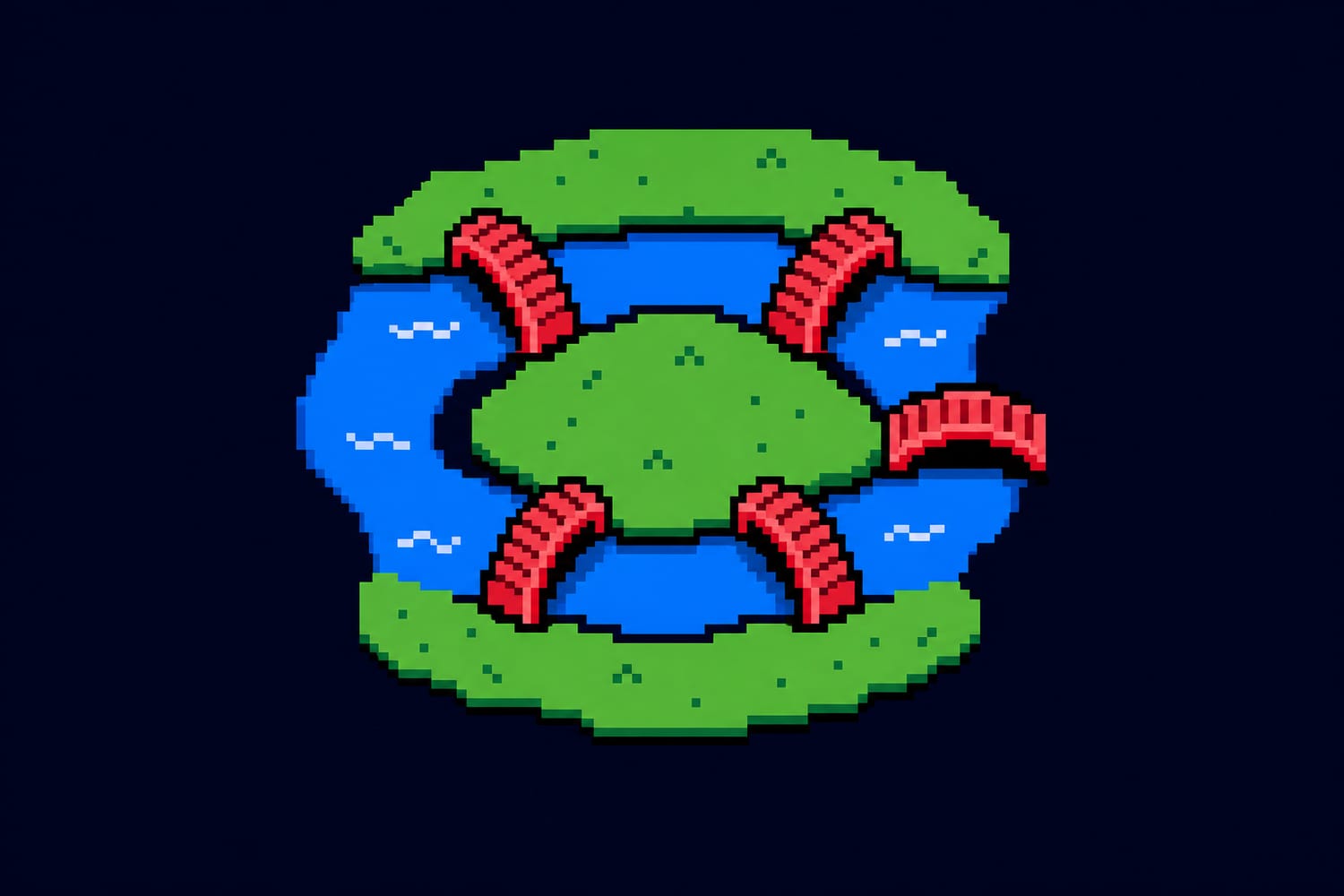
Königsberg had two large islands in the river, connected to each other and to the riverbanks by seven bridges. People in the city wondered about a simple-sounding challenge:
Could someone take a walk through Königsberg and cross each of the seven bridges exactly once?
Not twice. Not zero times. Exactly once.
At first, this sounds like the kind of puzzle you might solve by trial and error. Start here, cross that bridge, loop around, try again. Maybe there is a clever route hidden somewhere. Maybe you just need to begin in the right place.
But no matter how people tried, the walk never worked.
The puzzle became famous because it was easy to understand, yet strangely hard to solve. It did not require complicated numbers, advanced formulas, or special equipment. It was about walking across bridges. Anyone could try it.
And then a mathematician named Leonhard Euler looked at the problem in a completely new way.
The Seven Bridges of Königsberg
To understand the puzzle, imagine the city divided into four main land areas:
- The north bank of the river
- The south bank of the river
- One island
- Another island
These four land areas were connected by seven bridges. The exact shapes of the islands, the width of the river, and the length of the bridges did not really matter. What mattered was only this:
- Which land areas were connected?
- How many bridges connected them?
This was the key insight.
Most people thought about the puzzle as a map. Euler thought about it as a pattern of connections. Instead of drawing detailed streets, houses, and riverbanks, he simplified the city into dots and lines.
Each land area became a dot, now called a vertex or node.
Each bridge became a line, now called an edge.
This kind of drawing is called a graph. Not a graph like a bar chart or a line chart, but a mathematical graph: a collection of points connected by lines.
By changing the city into a graph, Euler transformed a walking puzzle into a new kind of mathematics.
Euler’s Brilliant Simplification
Leonhard Euler was one of the greatest mathematicians of all time. He worked in many areas, including number theory, physics, astronomy, and geometry. But in the Königsberg bridge problem, his genius came from asking a surprisingly practical question:
What must be true for such a walk to be possible?
Euler realized that the actual walking path through each land area mattered less than how many bridges touched that land area.
Think about what happens when you enter a piece of land during the walk. If you arrive by one bridge, you usually need to leave by another bridge. That uses two bridges: one in, one out.
So for most land areas, bridges should come in pairs.
For example, if a land area has 4 bridges connected to it, you could enter and leave twice. If it has 6 bridges, you could enter and leave three times.
But if a land area has 3 bridges, something awkward happens. You might enter and leave once, using two bridges, but then one bridge remains unpaired. That means the path must either start there or end there.
This observation leads to the heart of the solution.
Odd and Even: The Secret Behind the Puzzle
In graph theory, the number of edges connected to a vertex is called its degree.
If a land area has 3 bridges attached, its degree is 3. If it has 4 bridges attached, its degree is 4.
Euler discovered that the possibility of the walk depends on whether the degrees of the vertices are odd or even.
Here are the basic rules:
- If you want to start and end in the same place while crossing every bridge exactly once, then every vertex must have an even degree.
- If you want to start in one place and end in another, then exactly two vertices may have odd degree.
- If more than two vertices have odd degree, the walk is impossible.
Why?
Because every time you pass through a land area, you need one bridge to enter and one bridge to leave. That makes pairs. Even numbers can be perfectly paired. Odd numbers cannot, except possibly at the beginning and end of the journey.
The starting point can have an “extra” bridge used to leave. The ending point can have an “extra” bridge used to arrive. That is why a path with exactly two odd vertices can work.
But Königsberg had four land areas of odd degree.
That meant there were too many places with unpaired bridges. No matter where you started, no matter how clever your route was, you could not cross every bridge exactly once.
The famous walk was impossible.
Why the Answer Was So Revolutionary
At first, Euler’s answer might sound like a disappointment. The solution was: “No, you cannot do it.”
But in mathematics, proving that something is impossible can be just as powerful as finding a solution. Euler did not merely fail to find a route. He proved that no route could exist.
That proof was revolutionary because it did not depend on trying every possible path. Instead, it used logic to show that all attempts must fail.
This was a major step forward. Euler had created a method that applied not just to Königsberg, but to any similar network of paths and connections.
The Königsberg bridge problem is now considered the beginning of graph theory, a branch of mathematics that studies networks.
Today, graph theory helps us understand:
- Road systems
- Computer networks
- Social media connections
- Airline routes
- Electrical circuits
- Delivery routes
- Family trees
- Website links
- Game maps
- Puzzle paths
In other words, Euler’s “bridge puzzle” was not just about bridges. It was about connections, movement, and structure.
Eulerian Paths and Eulerian Circuits
Because of Euler’s work, mathematicians named two important ideas after him.
An Eulerian path is a route through a graph that uses every edge exactly once. It does not have to end where it began.
An Eulerian circuit is a route through a graph that uses every edge exactly once and returns to the starting point.
The Königsberg bridge puzzle asked whether the city’s bridges formed an Eulerian path or circuit. Euler showed that they did not.
Here is the rule in simple form:
| Type of route | What must be true? | |---|---| | Eulerian circuit | Every vertex has even degree | | Eulerian path | Exactly 0 or 2 vertices have odd degree | | Impossible | More than 2 vertices have odd degree |
If all vertices are even, you can start anywhere, cross every edge once, and return to where you began.
If exactly two vertices are odd, you can still cross every edge once, but you must start at one odd vertex and end at the other.
If there are four odd vertices, as in Königsberg, the task cannot be done.
This simple rule is one reason the puzzle is so satisfying. It takes a messy-looking challenge and turns it into something you can solve by counting.
A Tiny Example You Can Try
Imagine a triangle: three dots connected in a loop by three lines.
Each dot has degree 2, because two lines touch it. All degrees are even. So you can trace the whole triangle without lifting your pencil and return to where you started.
Now imagine a simple line of three dots: A—B—C.
Dot A has degree 1, dot B has degree 2, and dot C has degree 1. There are exactly two odd vertices: A and C. You can trace the whole graph by starting at A and ending at C, or starting at C and ending at A.
Now imagine a shape like a capital “T.” The center point has degree 3, and the three ends each have degree 1. That gives four odd vertices. You cannot trace every line exactly once without lifting your pencil or retracing.
That is the same kind of problem Königsberg had.
The Puzzle’s Lasting Legacy
The original bridges of Königsberg have changed over time. Some were destroyed, rebuilt, or replaced. The city itself changed dramatically through history. But the mathematical idea remains untouched.
Euler’s solution showed that math is not only about numbers. It can also be about relationships.
Before this puzzle, geometry mostly focused on measurements: lengths, angles, areas, and shapes. Euler’s method ignored measurements almost completely. It did not matter how long the bridges were. It did not matter whether the islands were round, narrow, or oddly shaped.
Only the connections mattered.
This way of thinking later influenced topology, sometimes described as “rubber-sheet geometry,” where shapes can be stretched or bent without changing their essential structure. It also helped create the modern study of networks, which is now important in science, engineering, computer programming, biology, and even sociology.
Every time a navigation app finds a route, every time a computer sends information across the internet, and every time a social network suggests a connection, graph theory is quietly working behind the scenes.
Not bad for a puzzle about an afternoon walk.
Why This Puzzle Is Still Fun Today
The Königsberg bridge puzzle remains popular because it is simple, surprising, and deep. You do not need to be a professional mathematician to understand the question. You can draw it on paper, test routes, and feel the frustration that people felt centuries ago.
Then, with one clever idea—counting odd and even connections—the mystery clears.
That is what makes great puzzles special. They invite us in with curiosity, challenge our assumptions, and reward us with a new way of seeing the world.
The impossible walk across the seven bridges of Königsberg did more than stump a city. It helped launch an entire branch of mathematics. It showed that sometimes the most amazing feats are not about building taller towers or crossing wider rivers.
Sometimes, the amazing feat is realizing that the answer has been hidden in the connections all along.

