
The Chessboard and Wheat Puzzle: The Simple Request That Grows to 18 Quintillion Grains
A Simple Request With an Astonishing Answer
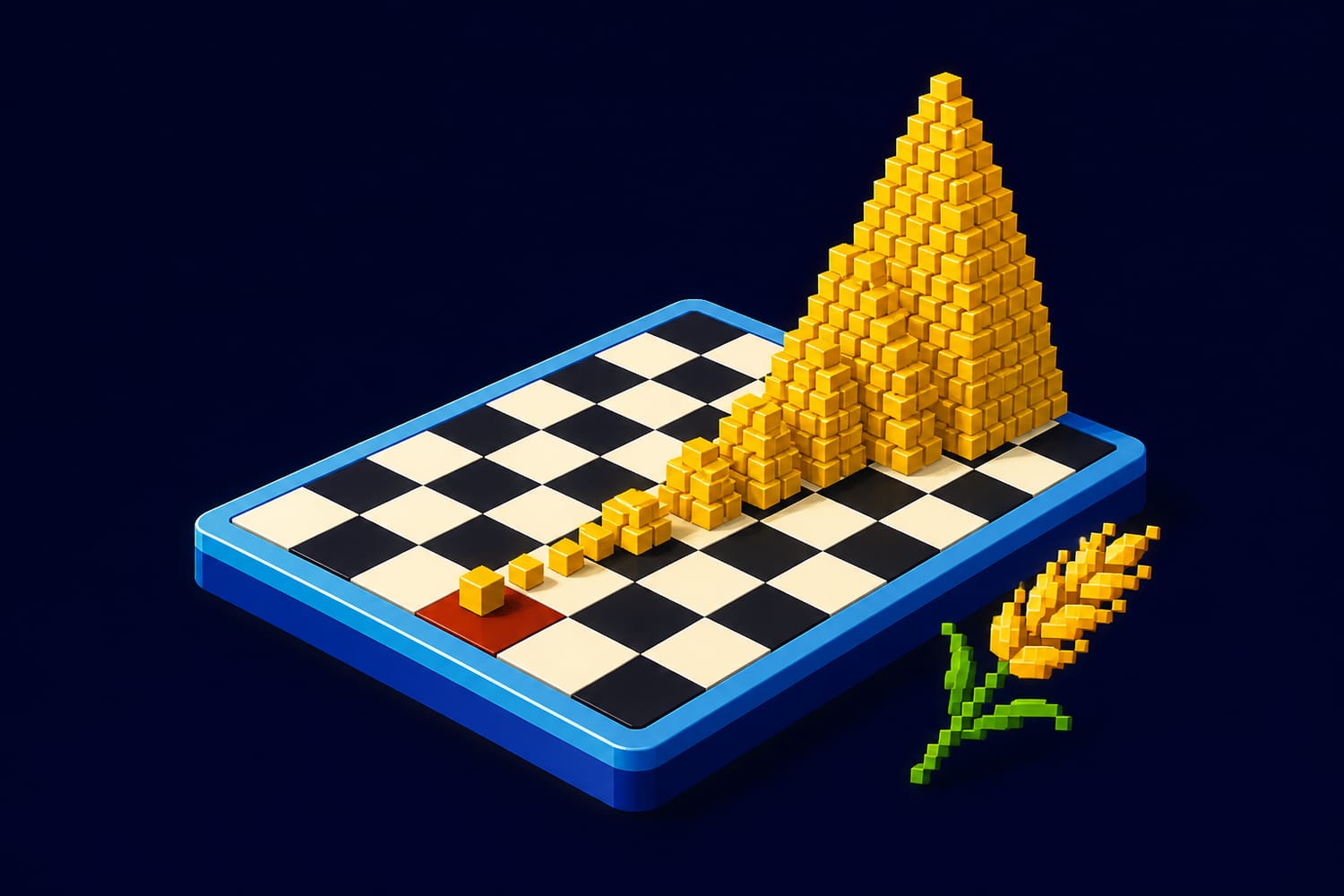
The chessboard and wheat puzzle asks you to place one grain on the first square, two on the second, four on the third, and continue doubling across all 64 squares. The final total is 18,446,744,073,709,551,615 grains—more than 18 quintillion and far beyond what intuition suggests.
At first, the request sounds almost laughably modest. A single grain of wheat is tiny, and even a few handfuls would hardly trouble a wealthy ruler. Yet the puzzle hides one of mathematics’ most powerful forces: exponential growth.
This famous thought experiment is often told as a legend about the inventor of chess asking a king for a reward. Names, locations, and even the type of grain vary between versions, so the story should be treated as a traditional mathematical tale rather than a confirmed historical event. Its lesson, however, is timeless.
The Legendary Bargain
According to the best-known version, a wise person presents the game of chess to a delighted king. The king offers a magnificent reward—gold, land, jewels, or anything else the inventor desires.
The inventor makes what appears to be a humble request:
- Place one grain of wheat on the first chessboard square.
- Place two grains on the second.
- Place four grains on the third.
- Continue doubling the amount on every following square.
- Stop after filling all 64 squares.
The king readily agrees. After all, the sequence begins with just:
1, 2, 4, 8, 16, 32, 64, 128…
Nothing about those first few numbers seems threatening. The surprise arrives because every new square receives twice as much as the one before it. The increase does not remain small for long.
Why Doubling Becomes So Powerful
There are two common ways quantities grow.
With linear growth, the same amount is added repeatedly. If five grains were added on every square, the totals would increase steadily: 5, 10, 15, 20, and so on.
With exponential growth, the current amount is multiplied by the same factor. In the wheat puzzle, that factor is two. Each step is based on everything already reached by the previous step.
The difference becomes dramatic:
| Square | Grains on that square | |---:|---:| | 1 | 1 | | 2 | 2 | | 4 | 8 | | 8 | 128 | | 16 | 32,768 | | 24 | 8,388,608 | | 32 | 2,147,483,648 | | 40 | 549,755,813,888 | | 50 | 562,949,953,421,312 | | 60 | 576,460,752,303,423,488 | | 64 | 9,223,372,036,854,775,808 |
By square 32, one square alone requires more than two billion grains. By square 40, the amount on that square exceeds half a trillion.
This same hidden power of doubling appears in another classic challenge, the 64-disk Tower of Hanoi puzzle. Remarkably, its minimum number of moves is also (2^{64}-1).
Calculating the Total
The amount placed on each square can be written using powers of two:
- Square 1: (2^0=1)
- Square 2: (2^1=2)
- Square 3: (2^2=4)
- Square 4: (2^3=8)
- Square 64: (2^{63})
Notice that the exponent is one less than the square number. This happens because the first square begins with (2^0), not (2^1).
To find the total, we add all 64 amounts:
[ 1+2+4+8+\cdots+2^{63} ]
This is known as a finite geometric series. A geometric series is a sum in which each term is created by multiplying the previous term by a constant ratio. Readers who want to explore the general rule can review Khan Academy’s guide to the finite geometric series formula.
For this particular doubling pattern, the sum has a wonderfully compact form:
[ 1+2+4+\cdots+2^{n-1}=2^n-1 ]
With 64 squares:
[ 2^{64}-1=18,446,744,073,709,551,615 ]
That exact solution is also given in Wolfram MathWorld’s explanation of the wheat and chessboard problem.
In the short-scale numbering system used in the United States, this is approximately 18.4 quintillion grains.
A Clever Way to See Why the Formula Works
You do not have to memorize the formula to understand it.
Call the total (S):
[ S=1+2+4+8+\cdots+2^{63} ]
Now double everything:
[ 2S=2+4+8+16+\cdots+2^{64} ]
Subtract the original line from the doubled line. Nearly every term cancels:
[ 2S-S=2^{64}-1 ]
Therefore:
[ S=2^{64}-1 ]
This cancellation trick reveals why a giant addition problem can be solved with one exponent and one subtraction.
The Last Square Holds More Than All the Others Combined
The 64th square contains:
[ 2^{63}=9,223,372,036,854,775,808 ]
Meanwhile, the first 63 squares together contain:
[ 2^{63}-1=9,223,372,036,854,775,807 ]
That means the final square holds exactly one grain more than all the previous 63 squares combined.
The halfway point is equally deceptive. Squares 1 through 32 contain a total of:
[ 2^{32}-1=4,294,967,295 ]
That is already more than four billion grains. Yet it represents only a tiny fraction of the final answer. Square 33 alone contains 4,294,967,296 grains—one more than the entire first half of the board.
This is why exponential growth is difficult to judge by looking at its early stages. For much of the board, the request seems merely large. Near the end, it becomes almost unimaginable.
How Much Would All That Wheat Weigh?
Wheat kernels vary in mass according to variety and growing conditions, so no single weight estimate can be exact. One published study reported a range of 33.79 to 35.29 grams per 1,000 kernels for the wheat it examined.
Using that range, the chessboard’s wheat would weigh approximately 623 billion to 651 billion metric tons.
That estimate is not part of the puzzle’s fixed mathematical answer—it is simply a way to visualize the scale. Change the type or average mass of the grain, and the weight changes. The grain count remains exactly the same.
There would also be enormous practical problems involving harvesting, transportation, storage, and spoilage. The king’s promise was not merely expensive; it was physically impossible to fulfill as described.
What If You Counted the Grains One by One?
Suppose someone counted one grain every second without resting.
Counting all 18,446,744,073,709,551,615 grains would take approximately 584.5 billion years. That ignores sleep, meals, mistakes, and the fact that no human could survive long enough to make meaningful progress.
Even dramatically faster counting would not make the task manageable. At one million grains per second, it would still take more than 584,000 years.
Why This Puzzle Still Matters
The chessboard and wheat puzzle is entertaining, but it also teaches a serious lesson about judging quantities.
Exponential patterns appear in areas such as:
- Compound interest
- Computer data and storage
- Population models
- Chain reactions
- Viral sharing
- Algorithms and calculation time
Real-world systems rarely continue doubling forever because resources, space, and other limits eventually interfere. Still, the puzzle shows what repeated multiplication can do before those limits are reached.
It also demonstrates why mathematics is such an important part of puzzle solving. As explored in the hidden math behind popular puzzle games, a simple rule can generate consequences that are anything but simple.
The chessboard itself has inspired many mathematical challenges. In the Eight Queens Challenge, the same 64-square board becomes a testing ground for logic, symmetry, and systematic search.
A Small Beginning With a Giant Finish
The chessboard and wheat puzzle endures because its setup can be understood in seconds, while its answer stretches the imagination.
One grain becomes two. Two become four. The first row ends with only 128 grains on its final square. Yet after 64 squares, the total reaches more than 18 quintillion.
The lesson is not simply that the number is large. It is that repeated doubling behaves differently from the steady growth we encounter in everyday life. Small beginnings can hide extraordinary endings, and intuition alone may fail long before the numbers stop growing.
That is what makes this humble request one of the greatest amazing feats in recreational mathematics: a single grain, a familiar board, and a pattern powerful enough to overwhelm a kingdom.

