
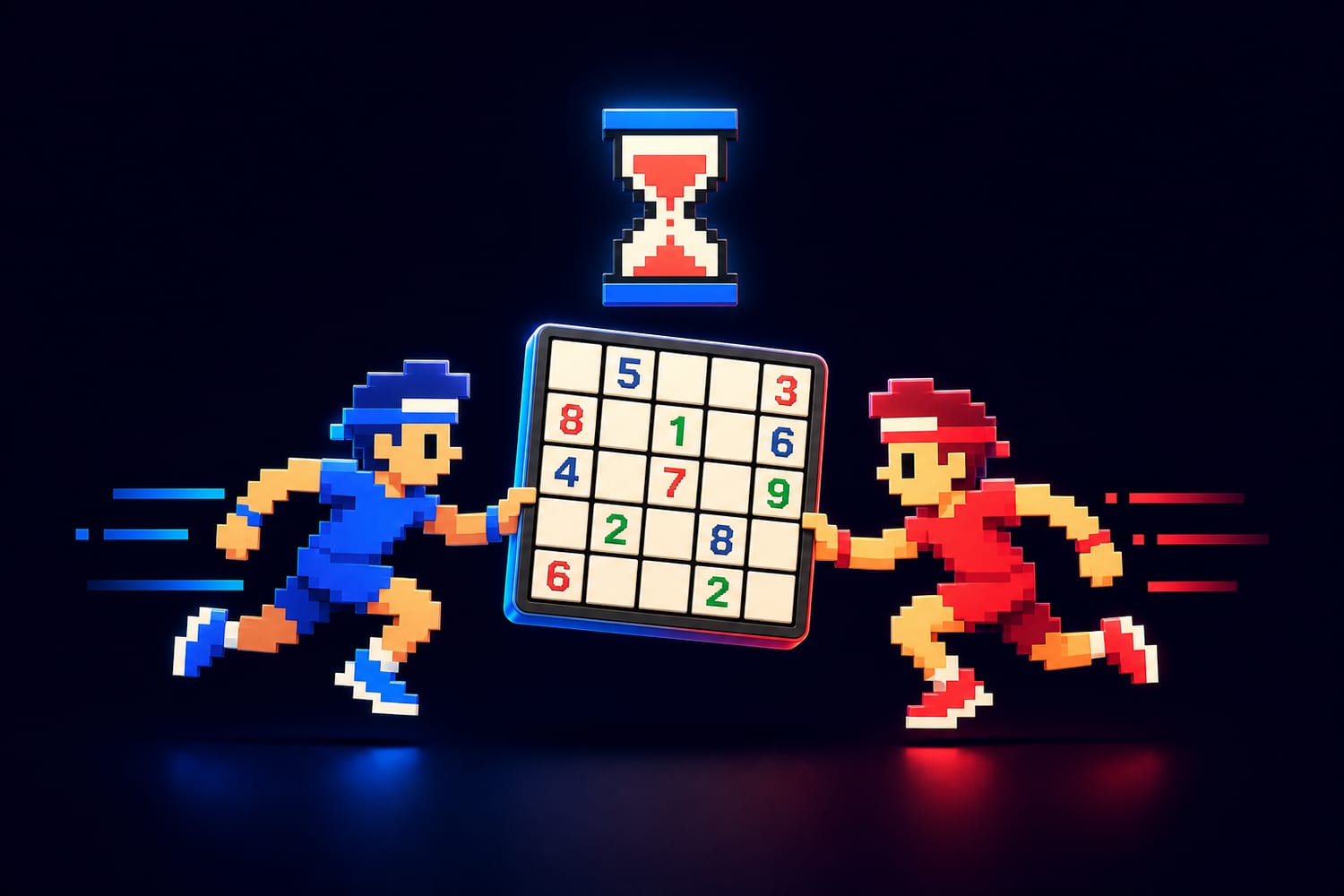
The 24-Hour Sudoku Relay: How Solvers Conquered One Impossible Grid
When a Puzzle Becomes an Endurance Sport
Sudoku is usually a quiet puzzle: a pencil, a grid, and a few minutes of concentration. But in the world of extreme puzzle solving, Sudoku can become something much bigger—an endurance challenge, a team strategy game, and a test of communication under pressure.
That is the spirit behind the idea of the 24-hour Sudoku relay: a group of solvers working in shifts to conquer a single brutally difficult grid. The puzzle may look like an ordinary 9-by-9 Sudoku, but the experience is closer to a marathon than a coffee-break brainteaser.
The word “impossible” is important here. In a proper Sudoku, “impossible” does not mean the puzzle has no answer. A valid Sudoku puzzle has one correct solution. Instead, “impossible” usually means that the puzzle is so difficult that ordinary solving habits are not enough. The grid may require advanced logic, careful notation, and the ability to spot patterns that are nearly invisible at first glance.
That is what makes such a relay fascinating. It is not just about who is fastest. It is about how humans organize thought, share discoveries, avoid mistakes, and keep going when the grid refuses to give up its secrets.
The Grid: Simple Rules, Enormous Depth
Sudoku’s rules are famously easy to learn. Fill a 9-by-9 grid with the digits 1 through 9 so that each number appears exactly once in every row, every column, and every 3-by-3 box.
That’s it.
But those simple rules create a surprisingly deep logical world. A beginner puzzle might be solved by scanning rows and columns for missing numbers. A medium puzzle may require writing small “candidate” numbers in each empty square. A very hard puzzle might demand techniques with names like X-Wing, Swordfish, XY-Chain, coloring, or forcing chains.
In an extreme Sudoku, progress can be painfully slow. A team might spend an hour proving that a single tiny candidate—say, a 7 in the corner of one cell—cannot be correct. That may not sound dramatic, but in a hard puzzle, removing one wrong possibility can unlock a chain reaction across the entire grid.
The puzzle in a 24-hour relay is not “beaten” by luck. It is beaten by accumulated certainty. Every step must be justified. Every note matters.
Why Use a Relay?
At first, a relay may seem unnecessary. Why not just let the best solver sit down and finish the puzzle?
The answer is that endurance changes everything. After several hours, even expert solvers get tired. Eyes blur. Patterns become harder to see. A simple mistake—such as forgetting that a number already appears in a row—can ruin the entire grid.
A relay helps solve this problem by dividing the work into shifts. One solver or small group works for a set period, then hands the puzzle to the next solver. The new solver arrives with fresh eyes and fresh energy. Often, a pattern that was invisible to one person becomes obvious to another.
This is one of the most interesting lessons of puzzle relays: fresh perspective is a real tool. A solver who has stared at the same grid for two hours may become trapped in one way of thinking. Someone new may ask, “Why hasn’t anyone checked this box?” and suddenly the next step appears.
Of course, a relay also creates a challenge. Every handoff must be clear. The incoming solver needs to know what has been proven, what has only been guessed at, and which areas of the grid are dangerous. Without good communication, the team can waste hours repeating old work—or worse, build on an error.
The First Rule: No Unmarked Assumptions
In an ordinary puzzle session, solvers often keep ideas in their heads. In a 24-hour relay, that is risky. If one person notices a pattern but forgets to write it down, the next person may never know it existed.
Strong teams treat the Sudoku grid almost like a scientific experiment. They mark candidates carefully. They record eliminations. They label chains and assumptions. If they test a possibility, they note where it starts and what it proves.
For example, suppose a solver notices that in one row, the number 5 can appear only in two cells. That fact should be recorded clearly. Later, another solver may combine that information with a column pattern to eliminate 5 somewhere else.
This is how the grid slowly shrinks. Not by wild guessing, but by a long series of reliable facts.
There is also an important difference between a guess and a controlled trial. Guessing means placing a number because it “feels right.” Controlled trial means temporarily exploring a possibility and following the consequences logically. If the trial leads to a contradiction, the original possibility can be eliminated. In very difficult Sudoku puzzles, this kind of reasoning may be necessary, but it must be handled carefully.
The Handoff: Passing the Torch Without Dropping It
The most dramatic part of a Sudoku relay may not be the final digit. It may be the handoff.
Imagine one team member finishing a shift at 3:00 a.m. They are tired, but they have just discovered a complicated chain involving three boxes and four rows. If they explain it poorly, the next solver may not trust it. If they explain it too briefly, the logic may be lost. If they fail to mention uncertainty, the team may accidentally treat a possibility as a fact.
A good handoff usually includes:
- The current state of the grid
- Recent placements and why they are valid
- Important candidate eliminations
- Areas that seem promising
- Areas that have already been checked
- Any assumptions currently being tested
In other words, the outgoing solver does not simply say, “Good luck.” They pass along a map.
This is one reason Sudoku relays are educational. They show that solving is not just about intelligence. It is also about organization, patience, and communication.
The Techniques That Break the Wall
Every difficult Sudoku has moments where progress seems impossible. The grid sits there, stubborn and silent. All the obvious singles are gone. Every empty cell has multiple candidates. Nothing seems to move.
That is when advanced techniques enter.
A naked single is the simplest discovery: a cell has only one possible number left. A hidden single is slightly trickier: a number has only one possible place within a row, column, or box, even if that cell contains other candidates.
From there, the logic becomes more subtle. A naked pair happens when two cells in the same unit contain the same two candidates and nothing else. Those two numbers must occupy those two cells, so they can be removed from other cells in that row, column, or box.
An X-Wing is a pattern involving two rows and two columns. If a candidate appears in exactly the same two columns in two different rows, that candidate can be eliminated from other cells in those columns. It sounds technical, but visually it forms a rectangle—hence the name.
Chains are even more powerful. A chain follows “if this, then that” relationships across the grid. A well-built chain can prove that certain candidates cannot survive. These techniques require focus, and they are exactly the kind of discoveries that benefit from teamwork.
The amazing part is that one advanced elimination may create a simple result. After hours of complex logic, the reward might be a humble naked single. But that single can open the next door.
The Human Battle: Fatigue, Focus, and Trust
A 24-hour Sudoku relay is not only a logic challenge. It is a human challenge.
Solvers must manage fatigue. They need breaks, water, food, and sometimes the humility to step away. Staring longer is not always better. A tired brain may miss an easy clue or become too attached to a mistaken theory.
They also need trust. If a teammate has proven an elimination, the next solver should be able to rely on it. But trust does not mean blind acceptance. In strong teams, important deductions can be checked by another person. This balance—confidence plus verification—is essential.
There is also a psychological battle. Hard puzzles can feel personal. The grid seems to mock every effort. But experienced solvers know that being stuck is normal. In Sudoku, silence does not mean defeat. It means the next clue is hidden more deeply.
The Breakthrough Moment
In stories of extreme puzzle solving, the most exciting moment is often not the ending. It is the breakthrough—the moment when the puzzle changes from locked to flowing.
Perhaps a solver spots that a candidate chain forces the same result no matter which branch is true. Perhaps a hidden single appears in a box everyone thought was exhausted. Perhaps an earlier note, ignored for hours, suddenly combines with a new elimination.
Then the grid begins to collapse in the best possible way. One number is placed. That placement removes candidates from a row. Another single appears. A box resolves. A column opens. After hours of resistance, the Sudoku starts solving itself.
This is one of the joys of logical puzzles. The final grid may look neat and inevitable, but the path to reach it was full of uncertainty, patience, and discovery.
Why This Feat Matters
A 24-hour Sudoku relay is amazing not because Sudoku has complicated rules. It is amazing because simple rules can produce deep challenges, and because people can overcome those challenges together.
For beginners, the lesson is encouraging: every expert solver started with basics. For experienced players, the relay shows the value of discipline and teamwork. For everyone, it is a reminder that difficult problems do not always fall to speed. Sometimes they fall to persistence.
Sudoku also teaches a kind of thinking that applies far beyond puzzles. Check your assumptions. Record your evidence. Look for patterns. Take breaks. Ask for help. Let fresh eyes review your work. Celebrate small progress.
The “impossible” grid is conquered one certainty at a time.
The Final Number
When the last digit finally goes into the grid, the victory is more than a completed Sudoku. It is the end of a shared journey. Every candidate note, every careful handoff, every late-night discovery, and every avoided mistake becomes part of the solution.
That is what makes the 24-hour Sudoku relay such a perfect entry in the world of amazing feats. It turns a familiar puzzle into an endurance event. It transforms solitary thinking into teamwork. And it proves that even the most intimidating grid can be solved when patience, logic, and collaboration stay in the game.
The final number may be just one digit—but after 24 hours, it feels like crossing a finish line.

