
The 12-Matchstick Challenge: How to Make Six Squares with Just 12 Sticks
Twelve Sticks, Six Squares: What’s the Trick?
You can make six squares with just 12 matchsticks by building the edge frame of a cube. Each stick becomes one edge; the cube’s six faces are the six squares. The surprising step is to lift the puzzle off the table. Nothing in the basic challenge says the sticks must stay flat.
Before reading on, try it yourself: gather 12 equal-length sticks, leave them unbroken, and see whether you can make six squares. If you are using real matches, use unlit ones. Toothpicks or small craft sticks work, too.
Why a Flat Arrangement Is So Tempting
Most of us begin by laying sticks on a table. Four sticks make one small square. Put another square beside it, and the two can share a side, saving a stick compared with building them separately. That feels like a promising route to six.
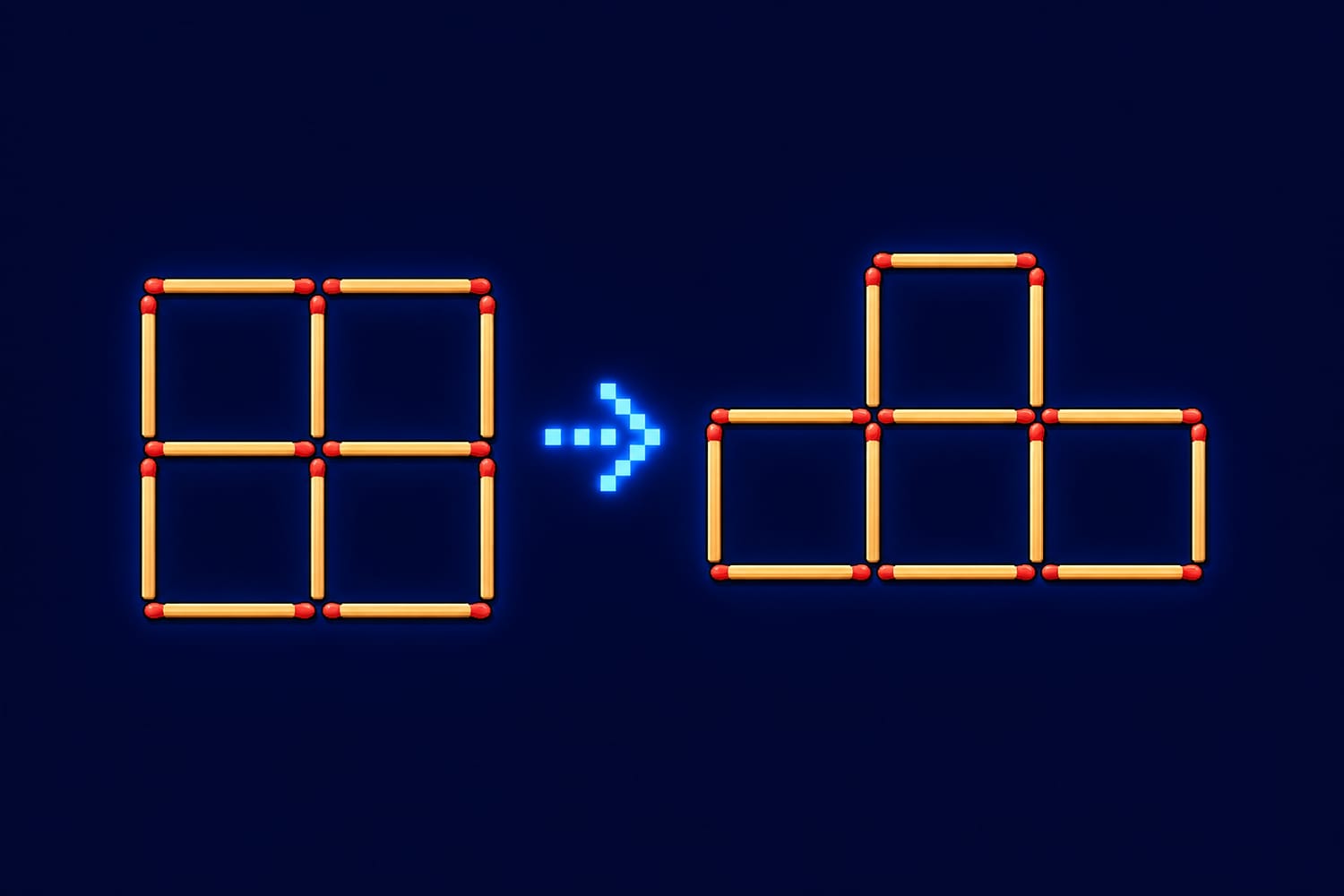
A familiar 2-by-2 grid shows how far sharing can take you. It uses exactly 12 sticks to outline four small squares. Count the large square around the outside as well, and you have five squares in total. The arrangement is clever—but still one short.
At this point, it is easy to spend ages shifting sticks around the same flat surface. The useful question is not “Which stick should move next?” It is “Why am I keeping every stick on the table?” This is a good example of the distinction in Puzzles Arcade’s guide to reading puzzle rules without adding assumptions: the goal and the restrictions are facts; an unstated restriction is not.
There is an important qualification. If your version of the puzzle explicitly requires a flat arrangement, the cube is not an allowed answer. The three-dimensional solution applies when the instructions let you arrange the sticks freely.
How to Build the Six-Square Solution
Picture a transparent box with every edge made from one stick. The bottom is a square, the top is a square, and four more squares stand between them. That is a cube frame.
You can assemble one in three stages:
- Make the bottom square. Lay four sticks end to end, with four right-angle corners.
- Add four upright edges. Place one stick at each corner, pointing upward. Keep them parallel and as close to vertical as you can.
- Make the top square. Join the four upper ends with your remaining four sticks. Keep this square directly above the bottom one.
Now count your materials: four sticks along the bottom, four standing upright, and four along the top. That is 4 + 4 + 4 = 12 sticks, with none left over.
Count the squares next. There is one on the bottom and one on the top. Each side is outlined by a bottom stick, a top stick, and two upright sticks: four more squares. That gives you 1 + 1 + 4 = 6. The bottom square is easy to miss when the frame is sitting on a table, so lift the model or look underneath it.
A free-standing frame made of loose sticks may fall apart before you can admire it. Small dabs of reusable putty or little pieces of tape at the corners can hold it together. The fasteners are supports, not extra edges of the puzzle. For a neat model, choose sticks of equal length and keep neighboring edges at right angles.
Why Twelve Edges Are Enough
Six separate squares would need 24 stick-sides: six squares multiplied by four sides each. So how can a 12-stick frame provide all 24?
Because every edge of a cube borders two faces. One stick can serve as a side of two different squares at the same time. Count the sides of all six faces and you count each physical stick twice. Divide 24 by two, and you get 12 distinct edges. A cube also has eight corners, called vertices. These are standard properties of the shape, not a special exception invented for the riddle.
Find the front-bottom edge on your model, for example. It belongs to the bottom square and the front square. The same double duty happens at every edge. This is what makes the solution economical: the sticks are not hidden, shortened, or counted as two objects. They simply belong to two squares at once.
You might wonder whether an open frame really makes a square when nothing fills its middle. It does. Four straight edges joined at right angles outline a square; a sheet of cardboard is not required. Imagine replacing the sticks with the edges of a clear box. You could still point to each of its six square faces.
The Tiny Feat Behind the “Aha!” Moment
The trick is less about quick hands than about changing your picture of the problem. On the table, you are designing a flat pattern. In the air, you are building an object. The same 12 sticks suddenly have a new way to share edges.
A flat drawing of a cube can help you imagine the answer, but a drawing has limits. The slanted lines in a sketch may not look equal in length, even though every edge of a real cube is equal. Making—or at least rotating—a physical model lets you check the shape from several directions. Puzzles Arcade’s article on practicing pattern rotation explores that useful habit of turning a shape in your mind rather than judging it from a single view.
The challenge also rewards careful counting. In the flat 2-by-2 grid, the outside border creates a larger fifth square in addition to the four small ones. In the cube, the square resting on the table still counts even when you cannot see through it clearly. In both cases, changing how you inspect the arrangement reveals a square you might overlook.
Try Two Follow-Up Challenges
Once you have found the cube, keep the sticks out for a little longer. These questions turn the solution into a chance to explore, rather than a trick you see only once.
Can you identify every face without moving the model? Point to the six squares and name them by position. Then rotate the cube and repeat. You will notice that “top” and “front” describe how you are holding it; the number of square faces stays the same.
Can you predict what happens if one edge is removed? Choose a stick and identify the two square faces that use it before taking it away. Both of those face outlines will be broken. Put the stick back and test your prediction. This is a hands-on way to see why each edge was counted twice.
For another small-object puzzle with a surprisingly large set of possibilities, explore Puzzles Arcade’s 12-coin counterfeit challenge. It asks for a different kind of reasoning, but offers a similar invitation: pause before deciding what the problem must be asking you to do.
The Takeaway
The answer is a cube: 12 sticks form its 12 edges, and those edges outline six square faces. The satisfying part is discovering that “make squares” never required “keep them flat.” Once you allow the sticks to rise off the table, the impossible-looking sixth square has been waiting there all along.

